
Join Our JEE Preparation Group
Prep with like-minded aspirants; Get access to free daily tests and study material.
Sign in
Please select an account to continue using cracku.in
↓ →
Join Our JEE Preparation Group
Prep with like-minded aspirants; Get access to free daily tests and study material.
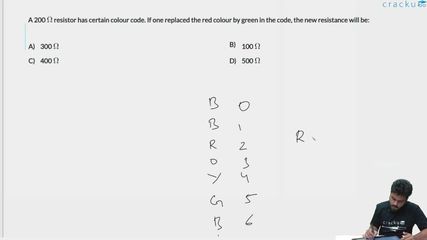
A 200 $$\Omega$$ resistor has certain colour code. If one replaced the red colour by green in the code, the new resistance will be:
We recall the resistor colour-code convention. For the significant digits we have:
Black → 0, Brown → 1, Red → 2, Orange → 3, Yellow → 4, Green → 5, Blue → 6, Violet → 7, Grey → 8, White → 9.
In an ordinary three-band code the first two coloured rings give the first two digits of the resistance, while the third ring gives the multiplier, i.e. a factor of $$10^{\text{(third-band digit)}}$$.
The given resistance is $$200\;\Omega$$. Let us work out which colours must appear.
We want to write $$200$$ in the form $$(\text{first digit}\times 10 + \text{second digit}) \times 10^{\,\text{multiplier digit}}.$$
Observing $$200 = 20 \times 10^{1}$$ we identify
• First digit $$=2$$, so the first band is Red.
• Second digit $$=0$$, so the second band is Black.
• Multiplier digit $$=1$$, so the third band is Brown (because Brown represents 1 and hence the factor $$10^{1}$$).
Thus the original colour sequence is Red - Black - Brown, giving the required $$200\;\Omega$$.
Now the question says that every Red band is replaced by Green. In our code only the first band is Red, so only the first significant digit changes.
Green represents the digit $$5$$. Therefore, after the replacement we have
• First digit $$=5$$ (Green).
• Second digit $$=0$$ (Black).
• Multiplier digit remains $$=1$$ (Brown).
So the new resistance is calculated as follows:
We have $$\bigl(5 \times 10 + 0\bigr) \times 10^{1}$$.
First we evaluate the bracket:
$$5 \times 10 + 0 = 50.$$
Next we apply the multiplier $$10^{1}=10$$:
$$50 \times 10 = 500.$$
Hence the new resistance is $$500\;\Omega$$.
Hence, the correct answer is Option D.
Was this solution helpful?
Click on the Email ☝️ to Watch the Video Solution
Create a FREE account and get:
_1.webp)

Educational materials for JEE preparation

Ask our AI anything

AI can make mistakes. Please verify important information.
AI can make mistakes. Please verify important information.
