
Join Our JEE Preparation Group
Prep with like-minded aspirants; Get access to free daily tests and study material.
Sign in
Please select an account to continue using cracku.in
↓ →
Join Our JEE Preparation Group
Prep with like-minded aspirants; Get access to free daily tests and study material.
For the circuit shown, with $$R_1 = 1.0 \; \Omega$$, $$R_2 = 2.0 \; \Omega$$, $$E_1 = 2$$ V and $$E_2 = E_3 = 4$$ V, the potential difference between the points 'a' and 'b' is approximately (in V):
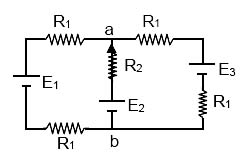
Between points $$a$$ and $$b$$, the circuit has three parallel branches.
Using the potential division method for parallel branches,
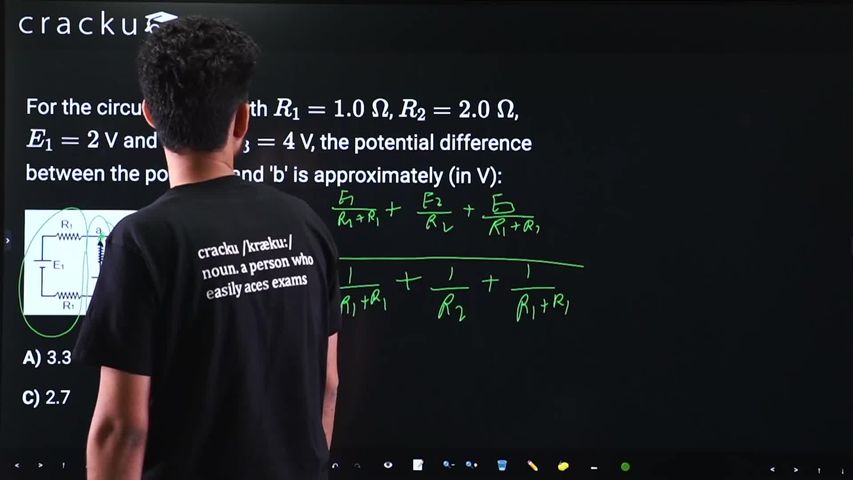
$$\Delta V= \frac{\dfrac{E_1}{R_1+R_1}+\dfrac{E_2}{R_2}+\dfrac{E_3}{R_1+R_1}} {\dfrac{1}{R_1+R_1}+\dfrac{1}{R_2}+\dfrac{1}{R_1+R_1}}$$
Given,
$$R_1=1\ \Omega,\qquad R_2=2\ \Omega,\ E_1=2\ V,\qquad E_2=E_3=4$$ V
Substituting,
$$\Delta V=\frac{\frac{2}{2}+\frac{4}{2}+\frac{4}{2}}{\frac{1}{2}+\frac{1}{2}+\frac{1}{2}}\ so,\ \Delta V=\frac{1+2+2}{3/2},\ \Delta V=\frac{5}{3/2},\ \Delta V\approx3.3$$ V
Hence,
$$\boxed{V_{ab}\approx 3.3\ \text{V}}$$
Was this solution helpful?
Click on the Email ☝️ to Watch the Video Solution
Create a FREE account and get:
_1.webp)

Educational materials for JEE preparation

Ask our AI anything

AI can make mistakes. Please verify important information.
AI can make mistakes. Please verify important information.
