
Join Our JEE Preparation Group
Prep with like-minded aspirants; Get access to free daily tests and study material.
Sign in
Please select an account to continue using cracku.in
↓ →
Join Our JEE Preparation Group
Prep with like-minded aspirants; Get access to free daily tests and study material.
Let the domain of the function $$f(x) = \log_2 \log_4 \log_6 (3 + 4x - x^2)$$ be $$(a, b)$$. If $$\int_0^{b-a} [x^2]\,dx = p - \sqrt{q} - \sqrt{r}$$, $$p, q, r \in \mathbb{N}$$, $$\gcd(p, q, r) = 1$$, then $$p + q + r$$ is equal to
The given function is $$f(x)=\log_{2}\!\Bigl[\log_{4}\!\bigl[\log_{6}(3+4x-x^{2})\bigr]\Bigr]$$.
For the domain, the argument of each logarithm must be positive.
Step 1 (innermost log)
$$3+4x-x^{2}\; \gt \;0$$ is needed for $$\log_{6}$$ to exist.
Step 2 (middle log)
For $$\log_{4}[\;]$$ we again need its argument positive:
$$\log_{6}(3+4x-x^{2})\; \gt \;0 \;\;\Longrightarrow\;\; 3+4x-x^{2}\; \gt \;6^{0}=1 .$$
Step 3 (outermost log)
Finally, $$\log_{2}[\;]$$ demands
$$\log_{4}\!\bigl[\log_{6}(3+4x-x^{2})\bigr]\; \gt \;0
\;\;\Longrightarrow\;\; \log_{6}(3+4x-x^{2}) \; \gt \;4^{0}=1
\;\;\Longrightarrow\;\; 3+4x-x^{2} \; \gt \;6 .$$
Simplify the last inequality:
$$3+4x-x^{2}\; \gt \;6
\;\;\Longrightarrow\;\; -x^{2}+4x-3 \; \gt \;0
\;\;\Longrightarrow\;\; x^{2}-4x+3 \; \lt \;0
\;\;\Longrightarrow\;\; (x-1)(x-3) \; \lt \;0.$$
The solution of $$(x-1)(x-3)\lt0$$ is $$1\lt x\lt3.$$
Hence the domain is $$(a,b)=(1,3),$$ so $$b-a=2.$$
We now evaluate the definite integral
$$\int_{0}^{\,b-a}[x^{2}]\,dx=\int_{0}^{2}[x^{2}]\,dx,$$
where $$[x^{2}]$$ denotes the greatest-integer (floor) function.
Break the interval $$[0,2]$$ wherever $$x^{2}$$ crosses an integer:
Compute the area on each sub-interval:
$$\begin{aligned} \int_{0}^{1}0\,dx &= 0,\\ \int_{1}^{\sqrt2}1\,dx &= (\sqrt2-1),\\ \int_{\sqrt2}^{\sqrt3}2\,dx &= 2(\sqrt3-\sqrt2),\\ \int_{\sqrt3}^{2}3\,dx &= 3(2-\sqrt3). \end{aligned}$$
Add them: $$\begin{aligned} 0 &+ (\sqrt2-1) + 2(\sqrt3-\sqrt2) + 3(2-\sqrt3) \\ &= \sqrt2-1 + 2\sqrt3-2\sqrt2 + 6-3\sqrt3 \\ &= 5 - \sqrt2 - \sqrt3. \end{aligned}$$
Thus
$$\int_{0}^{2}[x^{2}]\,dx = 5 - \sqrt2 - \sqrt3.$$
Comparing with $$p-\sqrt{q}-\sqrt{r},$$ we have $$p=5,\;q=2,\;r=3.$$
Because $$\gcd(5,2,3)=1,$$ the required sum is
$$p+q+r = 5+2+3 = 10.$$
Answer (Option A): 10
Was this solution helpful?
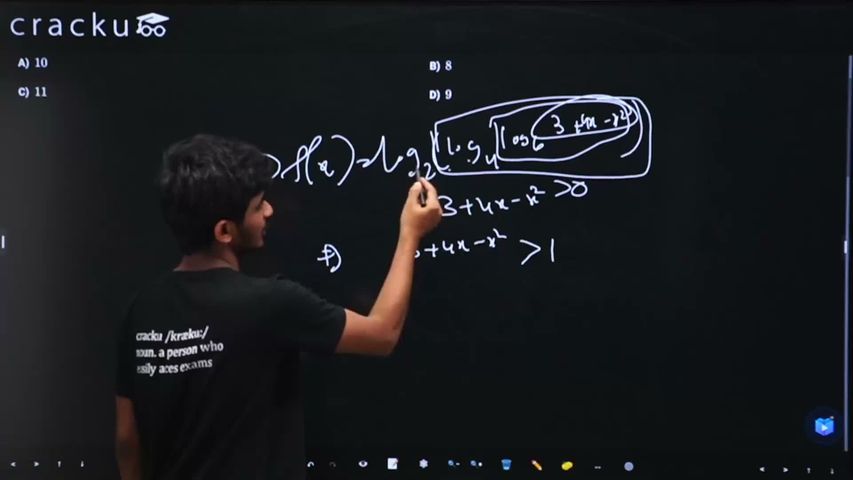
Click on the Email ☝️ to Watch the Video Solution
Create a FREE account and get:
_1.webp)

Educational materials for JEE preparation

Ask our AI anything

AI can make mistakes. Please verify important information.
AI can make mistakes. Please verify important information.


