
Join Our JEE Preparation Group
Prep with like-minded aspirants; Get access to free daily tests and study material.
Sign in
Please select an account to continue using cracku.in
↓ →
Join Our JEE Preparation Group
Prep with like-minded aspirants; Get access to free daily tests and study material.
Let $$a_1, a_2, a_3, \ldots$$ be a G.P. of increasing positive numbers. If $$a_3 a_5 = 729$$ and $$a_2 + a_4 = \frac{111}{4}$$, then $$24(a_1 + a_2 + a_3)$$ is equal to
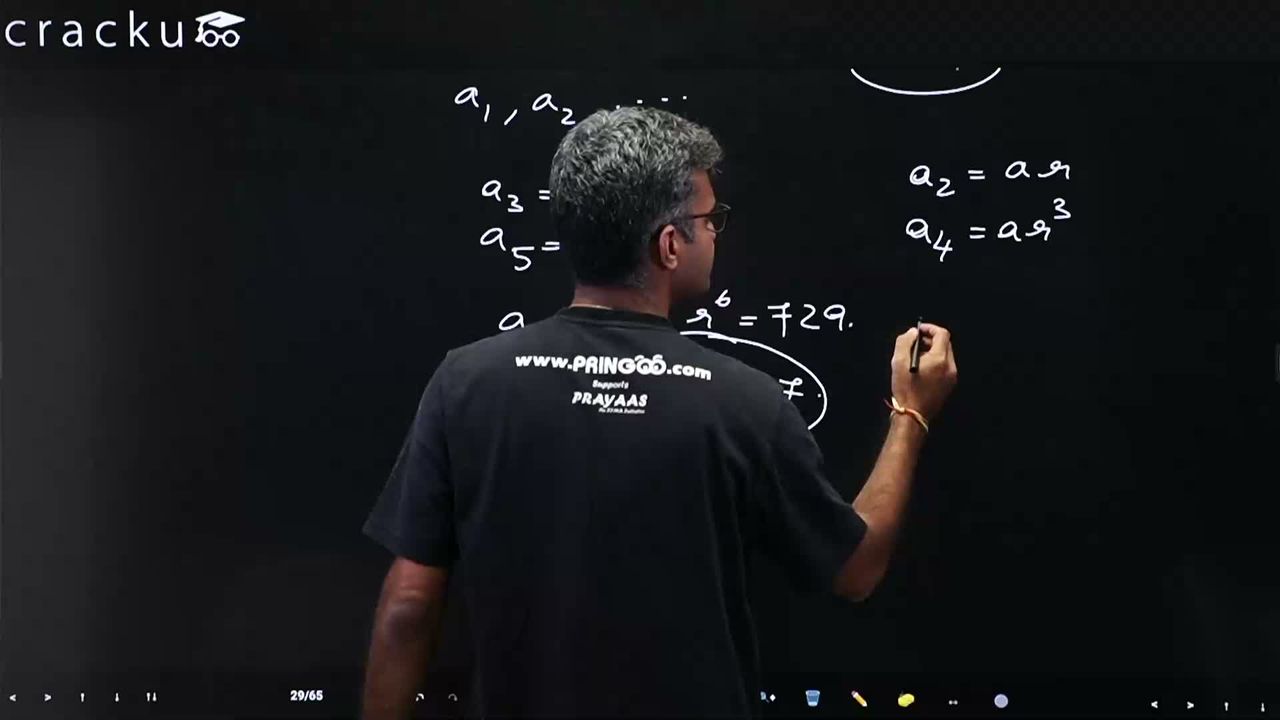
Let the first term of the G.P. be $$a$$ and the common ratio be $$r\;(\,r\gt1\,)$$, because the terms are increasing and positive.
Then the terms are
$$a_1 = a,\; a_2 = ar,\; a_3 = ar^{2},\; a_4 = ar^{3},\; a_5 = ar^{4}$$
Step 1 : Use the product condition
Given $$a_3\,a_5 = 729$$, substitute the expressions for $$a_3$$ and $$a_5$$:
$$(ar^{2})(ar^{4}) = a^{2}r^{6} = 729$$
Rewrite it as $$\bigl(a\,r^{3}\bigr)^{2} = 729$$, so
$$a\,r^{3} = \sqrt{729} = 27 \quad -(1)$$
Step 2 : Use the sum condition
Given $$a_2 + a_4 = \dfrac{111}{4}$$, substitute $$a_2$$ and $$a_4$$:
$$ar + ar^{3} = ar\,(1 + r^{2}) = \dfrac{111}{4} \quad -(2)$$
Step 3 : Eliminate $$a$$
From $$(1)$$, express $$a$$:
$$a = \dfrac{27}{r^{3}} \quad -(3)$$
Insert $$(3)$$ in $$(2)$$:
$$\dfrac{27}{r^{3}}\;r\,(1 + r^{2}) = \dfrac{111}{4}$$
$$\dfrac{27}{r^{2}}\,(1 + r^{2}) = \dfrac{111}{4}$$
Multiply both sides by $$r^{2}$$:
$$27\,(1 + r^{2}) = \dfrac{111}{4}\,r^{2}$$
Clear the fraction by multiplying by $$4$$:
$$108\,(1 + r^{2}) = 111\,r^{2}$$
Expand and group $$r^{2}$$ terms:
$$108 + 108\,r^{2} = 111\,r^{2}$$
$$108 = 3\,r^{2}$$
$$r^{2} = 36 \;\Longrightarrow\; r = 6$$ (only the positive value suits an increasing G.P.)
Step 4 : Find $$a$$
Substitute $$r = 6$$ in $$(3)$$:
$$a = \dfrac{27}{6^{3}} = \dfrac{27}{216} = \dfrac{1}{8}$$
Step 5 : Compute the required expression
The sum of the first three terms is
$$a_1 + a_2 + a_3 = a\,(1 + r + r^{2})$$
$$= \dfrac{1}{8}\,(1 + 6 + 36) = \dfrac{1}{8}\times 43 = \dfrac{43}{8}$$
Finally,
$$24\,(a_1 + a_2 + a_3) = 24 \times \dfrac{43}{8} = 3 \times 43 = 129$$
Hence, the value of $$24(a_1 + a_2 + a_3)$$ is $$129$$, which corresponds to Option C.
Was this solution helpful?
Click on the Email ☝️ to Watch the Video Solution
Create a FREE account and get:
_1.webp)

Educational materials for JEE preparation

Ask our AI anything

AI can make mistakes. Please verify important information.
AI can make mistakes. Please verify important information.


