
Join Our JEE Preparation Group
Prep with like-minded aspirants; Get access to free daily tests and study material.
Sign in
Please select an account to continue using cracku.in
↓ →
Join Our JEE Preparation Group
Prep with like-minded aspirants; Get access to free daily tests and study material.
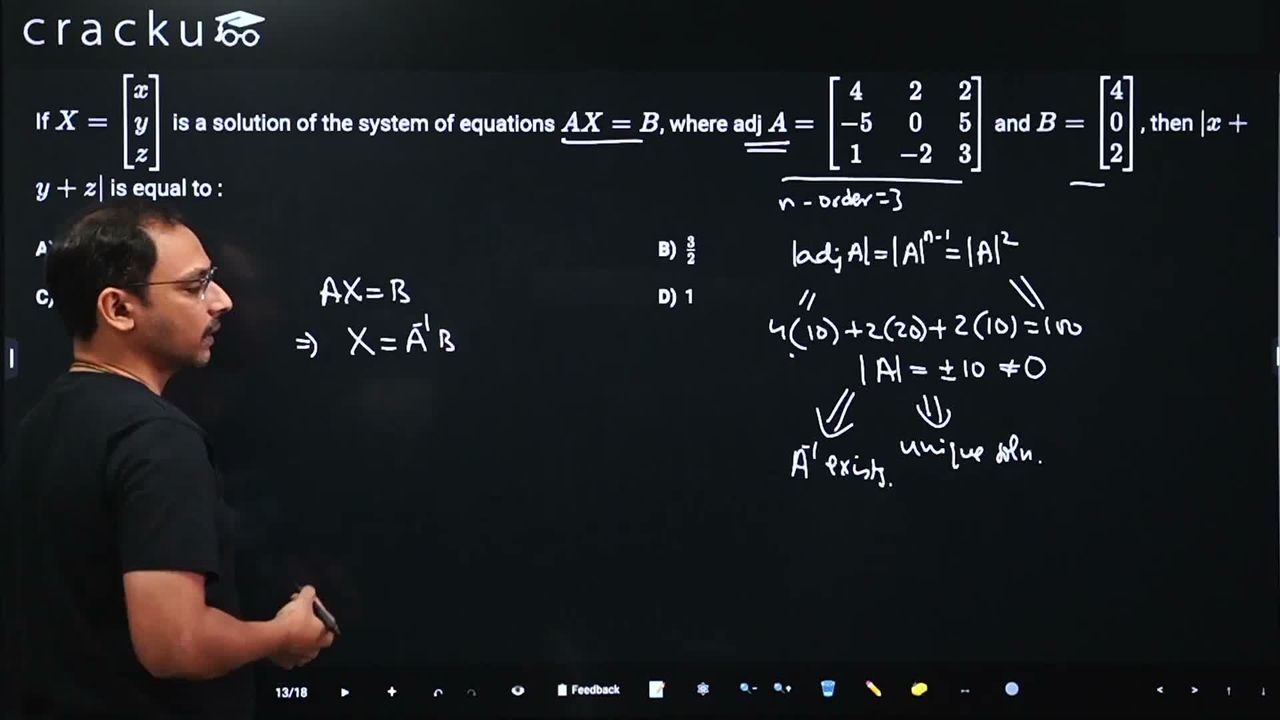
If $$X=\begin{bmatrix}x \\y \\z \end{bmatrix}$$ is a solution of the system of equations $$AX= B$$, where adj $$A= \begin{bmatrix}4 & 2 & 2 \\-5 & 0 & 5 \\1 & -2 & 3 \end{bmatrix}$$ and $$B=\begin{bmatrix}4 \\0 \\2 \end{bmatrix}$$, then $$|x+y+z|$$ is equal to :
Given: $$\text{adj}(A) = \begin{bmatrix} 4 & 2 & 2 \\ -5 & 0 & 5 \\ 1 & -2 & 3 \end{bmatrix}$$ and $$B = \begin{bmatrix} 4 \\ 0 \\ 2 \end{bmatrix}$$.
We know that $$A \cdot \text{adj}(A) = |A| \cdot I$$. Also, $$A^{-1} = \frac{\text{adj}(A)}{|A|}$$.
Since $$|\text{adj}(A)| = |A|^{n-1} = |A|^2$$ for a $$3 \times 3$$ matrix:
$$|\text{adj}(A)| = 4(0 \cdot 3 - 5 \cdot (-2)) - 2((-5)(3) - 5 \cdot 1) + 2((-5)(-2) - 0 \cdot 1)$$ = 100$$
So $$|A|^2 = 100$$, giving $$|A| = 10$$ (taking positive value).
The solution of $$AX = B$$ is $$X = A^{-1}B = \frac{1}{|A|}\text{adj}(A) \cdot B$$.
$$\text{adj}(A) \cdot B = \begin{bmatrix} 4 & 2 & 2 \\ -5 & 0 & 5 \\ 1 & -2 & 3 \end{bmatrix}\begin{bmatrix} 4 \\ 0 \\ 2 \end{bmatrix} = \begin{bmatrix} 16 + 0 + 4 \\ -20 + 0 + 10 \\ 4 + 0 + 6 \end{bmatrix} = \begin{bmatrix} 20 \\ -10 \\ 10 \end{bmatrix}$$
$$X = \frac{1}{10}\begin{bmatrix} 20 \\ -10 \\ 10 \end{bmatrix} = \begin{bmatrix} 2 \\ -1 \\ 1 \end{bmatrix}$$
So $$x = 2, y = -1, z = 1$$.
$$|x + y + z| = |2 - 1 + 1| = |2| = 2$$.
Was this solution helpful?
Click on the Email ☝️ to Watch the Video Solution
Create a FREE account and get:
_1.webp)

Educational materials for JEE preparation

Ask our AI anything

AI can make mistakes. Please verify important information.
AI can make mistakes. Please verify important information.
