
Join Our JEE Preparation Group
Prep with like-minded aspirants; Get access to free daily tests and study material.
Sign in
Please select an account to continue using cracku.in
↓ →
Join Our JEE Preparation Group
Prep with like-minded aspirants; Get access to free daily tests and study material.
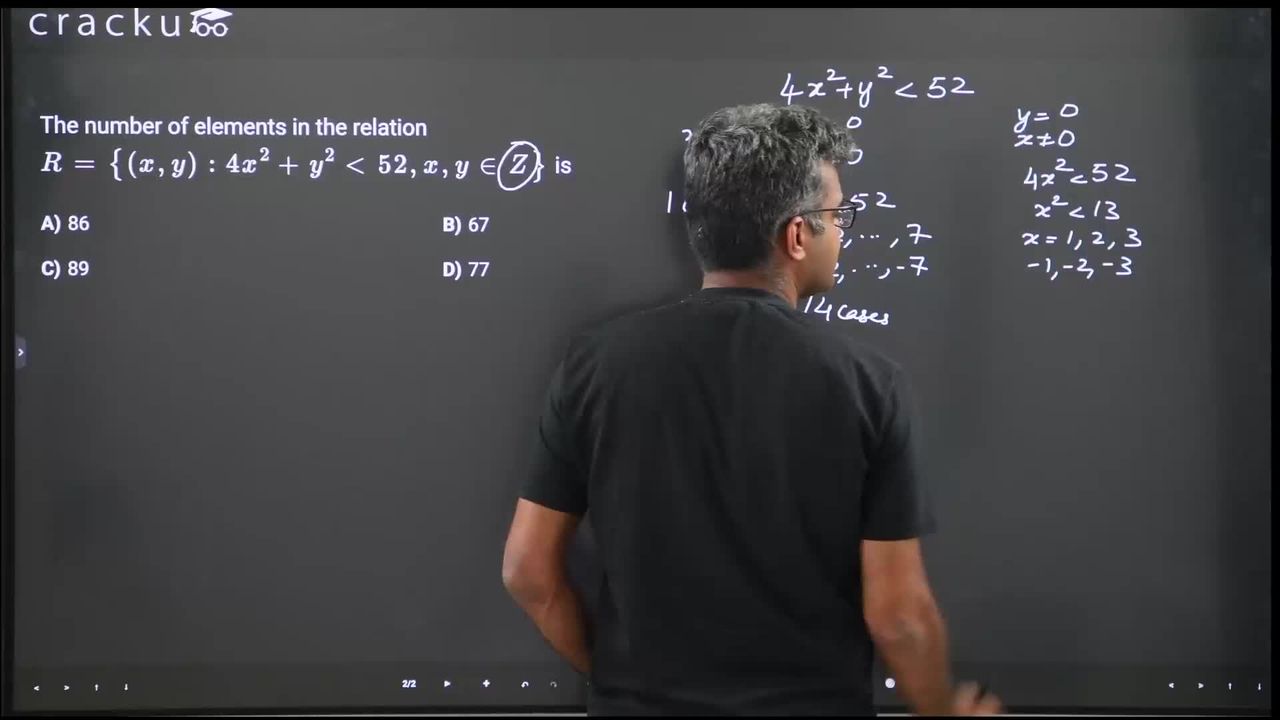
The number of elements in the relation $$R= \left\{(x,y): 4x^{2}+y^{2}<52,x,y\in Z\right\}$$ is
We have the relation, $$R= \left\{(x,y): 4x^{2}+y^{2}<52,x,y\in Z\right\}$$
where, $$4x^2+y^2<52$$ gives
$$\Rightarrow y^2< 52-4x^2$$
$$\Rightarrow y<\sqrt{52-4x^2}$$ or $$y>-\sqrt{52-4x^2}$$
Since $$\sqrt{k}$$ has to have $$k\geq 0$$, we find that $$4x^2$$ has to be less than or equal to $$52$$, i.e. $$x^2<13$$
Thus, for integral $$x$$, the values of $$x$$ can be $$-3, -2, -1, 0, 1, 2, 3$$
For $$x=-3$$ and $$x=3$$, we get $$y<\sqrt{52-36}$$ or $$y>-\sqrt{52-36}$$ which gives $$y<4$$ or $$y>-4$$, and hence $$7$$ values that satisfy. Giving a total of $$7\times 2= 14$$ cases.
For $$x=-2$$ and $$x=2$$, we get $$y<\sqrt{52-16}$$ or $$y>-\sqrt{52-16}$$ which gives $$y<6$$ or $$y>-6$$, and hence $$11$$ values that satisfy. Giving a total of $$11\times 2= 22$$ cases.
For $$x=-1$$ and $$x=1$$, we get $$y<\sqrt{52-4}$$ or $$y>-\sqrt{52-4}$$ which gives $$y<4\sqrt{3}$$ or $$y>-4\sqrt{3}$$, and hence $$13$$ values that satisfy. Giving a total of $$13\times 2= 26$$ cases.
For $$x=0$$, we get $$y<\sqrt{52-0}$$ or $$y>-\sqrt{52-0}$$ which gives $$y<7.21$$ or $$y>-7.21$$, and hence $$15$$ values that satisfy. Giving a total of $$15$$ cases.
Therefore, we have $$14+22+26+15=77$$ cases that satisfy.
Was this solution helpful?
Click on the Email ☝️ to Watch the Video Solution
Create a FREE account and get:
_1.webp)

Educational materials for JEE preparation

Ask our AI anything

AI can make mistakes. Please verify important information.
AI can make mistakes. Please verify important information.
