
Join Our JEE Preparation Group
Prep with like-minded aspirants; Get access to free daily tests and study material.
Sign in
Please select an account to continue using cracku.in
↓ →
Join Our JEE Preparation Group
Prep with like-minded aspirants; Get access to free daily tests and study material.
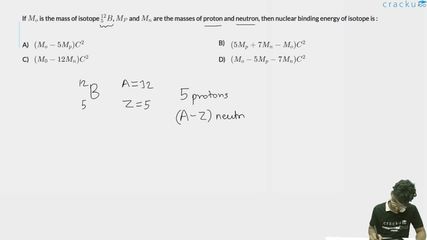
If $$M_o$$ is the mass of isotope $$^{12}_5 B$$, $$M_P$$ and $$M_n$$ are the masses of proton and neutron, then nuclear binding energy of isotope is :
We need to find the nuclear binding energy of the isotope $$^{12}_5 B$$ (Boron-12), given that $$M_o$$ is its mass, $$M_p$$ is the mass of a proton, and $$M_n$$ is the mass of a neutron.
The notation $$^{12}_5 B$$ tells us that the atomic number (Z) is 5, meaning there are 5 protons, and the mass number (A) is 12, indicating a total of 12 nucleons. Therefore, the number of neutrons is A - Z = 12 - 5 = 7 neutrons.
The mass defect ($$\Delta m$$) is the difference between the total mass of the individual nucleons (protons and neutrons) when separated and the actual mass of the nucleus. This "missing mass" has been converted into binding energy that holds the nucleus together, according to Einstein's mass-energy equivalence.
The total mass of individual nucleons is:
$$m_{nucleons} = 5M_p + 7M_n$$
The mass defect is:
$$\Delta m = m_{nucleons} - M_o = 5M_p + 7M_n - M_o$$
Note that $$\Delta m$$ is positive because the bound nucleus has less mass than the individual nucleons (energy has been released during binding).
Using Einstein's relation $$E = \Delta m \cdot C^2$$, the binding energy is:
$$\text{Binding Energy} = (5M_p + 7M_n - M_o)C^2$$
The correct answer is Option (2): $$(5M_p + 7M_n - M_o)C^2$$.
Was this solution helpful?
Click on the Email ☝️ to Watch the Video Solution
Create a FREE account and get:
_1.webp)

Educational materials for JEE preparation

Ask our AI anything

AI can make mistakes. Please verify important information.
AI can make mistakes. Please verify important information.
