
Join Our JEE Preparation Group
Prep with like-minded aspirants; Get access to free daily tests and study material.
Sign in
Please select an account to continue using cracku.in
↓ →
Join Our JEE Preparation Group
Prep with like-minded aspirants; Get access to free daily tests and study material.
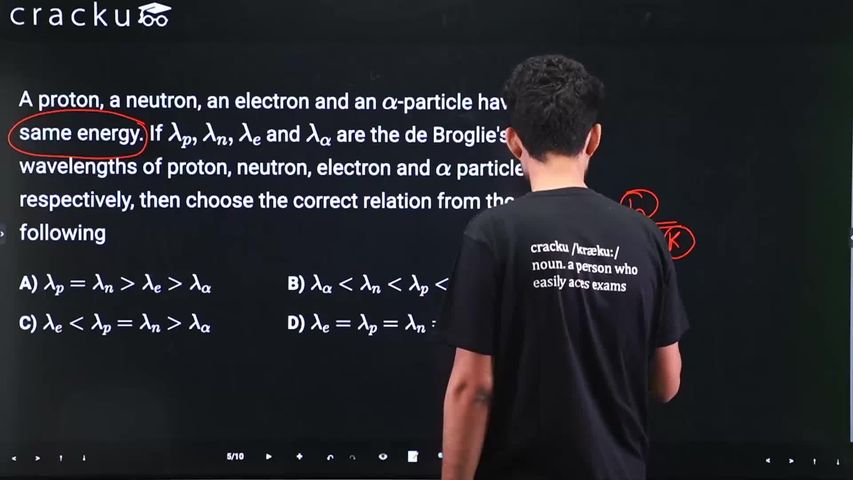
A proton, a neutron, an electron and an $$\alpha$$-particle have same energy. If $$\lambda_p, \lambda_n, \lambda_e$$ and $$\lambda_\alpha$$ are the de Broglie's wavelengths of proton, neutron, electron and $$\alpha$$ particle respectively, then choose the correct relation from the following
The de Broglie wavelength is given by:
$$\lambda = \frac{h}{p} = \frac{h}{\sqrt{2mE}}$$
where $$h$$ is Planck's constant, $$m$$ is the mass of the particle, and $$E$$ is the kinetic energy.
Since all particles have the same energy $$E$$:
$$\lambda \propto \frac{1}{\sqrt{m}}$$
The larger the mass, the smaller the wavelength.
Comparing masses:
- Electron: $$m_e$$ (smallest mass)
- Proton: $$m_p \approx 1836\, m_e$$
- Neutron: $$m_n \approx m_p$$ (slightly greater than proton mass)
- Alpha particle: $$m_\alpha \approx 4m_p$$ (largest mass)
Since $$m_e < m_p < m_n < m_\alpha$$:
$$\lambda_e > \lambda_p > \lambda_n > \lambda_\alpha$$
This can be rewritten as:
$$\lambda_\alpha < \lambda_n < \lambda_p < \lambda_e$$
Hence, the correct answer is Option B.
Was this solution helpful?
Click on the Email ☝️ to Watch the Video Solution
Create a FREE account and get:
_1.webp)

Educational materials for JEE preparation

Ask our AI anything

AI can make mistakes. Please verify important information.
AI can make mistakes. Please verify important information.


