
Join Our JEE Preparation Group
Prep with like-minded aspirants; Get access to free daily tests and study material.
Sign in
Please select an account to continue using cracku.in
↓ →
Join Our JEE Preparation Group
Prep with like-minded aspirants; Get access to free daily tests and study material.
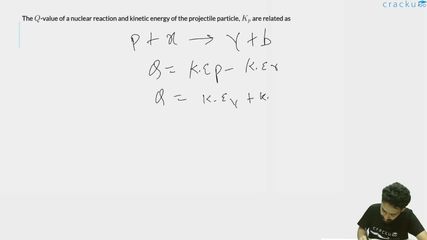
The $$Q$$-value of a nuclear reaction and kinetic energy of the projectile particle, $$K_p$$ are related as
$$x + p \rightarrow \gamma + b$$
Here,
p = projectile particle
x = target nucleus (remains stationary so its kinetic energy will be zero)
$$\gamma$$ and $$b$$ = products of the reaction
For a nuclear reaction,
$$Q = \text{Final K.E.} - \text{Initial K.E.}$$
So,
Q = $$K_{\gamma} + K_b - K_p$$
Rearranging,
$$Q + K_p = K_{\gamma} + K_b$$
Since kinetic energies of the products are always positive,
$$K_{\gamma} + K_b > 0$$
Hence,
$$\boxed{Q + K_p > 0}$$
Therefore, for the reaction to occur, the sum of the projectile kinetic energy and the Q-value must be positive.
Was this solution helpful?
Click on the Email ☝️ to Watch the Video Solution
Create a FREE account and get:
_1.webp)

Educational materials for JEE preparation

Ask our AI anything

AI can make mistakes. Please verify important information.
AI can make mistakes. Please verify important information.
