
Join Our JEE Preparation Group
Prep with like-minded aspirants; Get access to free daily tests and study material.
Sign in
Please select an account to continue using cracku.in
↓ →
Join Our JEE Preparation Group
Prep with like-minded aspirants; Get access to free daily tests and study material.
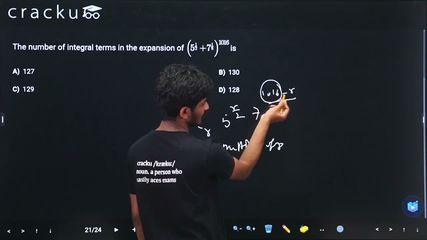
The number of integral terms in the expansion of $$\left(5^{\frac{1}{2}} + 7^{\frac{1}{8}}\right)^{1016}$$ is
Let the general term in the binomial expansion of $$\left(5^{1/2}+7^{1/8}\right)^{1016}$$ be $$T_{k+1}$$, where $$k$$ ranges from $$0$$ to $$1016$$.
Using the Binomial Theorem,
$$T_{k+1} = \binom{1016}{k}\,\left(5^{1/2}\right)^{1016-k}\,\left(7^{1/8}\right)^{k}$$
Simplify the powers of $$5$$ and $$7$$:
$$T_{k+1} = \binom{1016}{k}\,5^{\frac{1016-k}{2}}\;7^{\frac{k}{8}}$$ $$-(1)$$
For $$T_{k+1}$$ to be an integer, the exponents of both $$5$$ and $$7$$ must be non-negative integers.
Condition 1 (for the power of 7)
The exponent $$\dfrac{k}{8}$$ must be an integer ⟹ $$k$$ must be a multiple of $$8$$.
Condition 2 (for the power of 5)
The exponent $$\dfrac{1016-k}{2}$$ must be an integer.
Since $$1016$$ is even, $$\dfrac{1016-k}{2}$$ is an integer whenever $$k$$ is even.
If $$k$$ is a multiple of $$8$$, then $$k$$ is automatically even, so both conditions are satisfied simultaneously.
Hence, the permissible values of $$k$$ are all multiples of $$8$$ from $$0$$ up to $$1016$$ (inclusive):
$$k = 0,\,8,\,16,\,24,\,\dots,\,1016$$
The number of terms in this arithmetic sequence is
$$\text{Count} = \frac{1016}{8} + 1 = 127 + 1 = 128$$
Therefore, the expansion contains $$128$$ integral terms.
Option D is correct.
Click on the Email ☝️ to Watch the Video Solution
Create a FREE account and get:
_1.webp)

Educational materials for JEE preparation

Ask our AI anything

AI can make mistakes. Please verify important information.
AI can make mistakes. Please verify important information.


