
Join Our JEE Preparation Group
Prep with like-minded aspirants; Get access to free daily tests and study material.
Sign in
Please select an account to continue using cracku.in
↓ →
Join Our JEE Preparation Group
Prep with like-minded aspirants; Get access to free daily tests and study material.
PARAGRAPH 1
A frame of reference that is accelerated with respect to an inertial frameof reference is called a non-inertial frame of reference. A coordinate system fixed on a circular disc rotating about a fixed axis with a constant angular velocity $$\omega$$ is an example of a non-inertial frame of reference. The relationship between the force $$\overrightarrow{F}_{rot}$$ experienced by a particle of mass m moving on the $$\overrightarrow{F}_{in}$$ experienced by the particle in an inertial frame of reference is
$$ \overrightarrow{F}_{rot} = \overrightarrow{F}_{in} + 2m(\overrightarrow{V}_{rot} \times \overrightarrow{\omega}) + m(\overrightarrow{\omega} \times \overrightarrow{r}) \times \overrightarrow{\omega}$$,
where $$\overrightarrow{v}_{rot}$$ is the velocity of the particle in the rotating frameof reference and $$\overrightarrow{r}$$. is the position vector of the particle with respect to the centre of the disc.
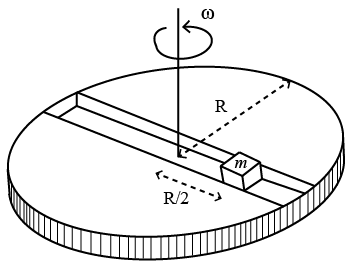
Now consider a smooth slot along a diameter of a disc of radius R rotating counter-clockwise with a constant angular speed $$\omega$$ about its vertical axis through its center. We assign a
coordinate system with the origin at the center of the disc, the x-axis along the slot, the y-axis perpendicular to the slot and the z-axis along the rotation axis $$(\overrightarrow{\omega} = \omega \hat{k})$$. A small block of mass m is gently placed in the slot at $$\overrightarrow{r} = \left(\frac{R}{2}\right)\hat{i}$$ at t = 0 and is constrained to move only along the slot.
Create a FREE account and get:
_1.webp)

Educational materials for JEE preparation

Ask our AI anything

AI can make mistakes. Please verify important information.
AI can make mistakes. Please verify important information.


