
Join Our JEE Preparation Group
Prep with like-minded aspirants; Get access to free daily tests and study material.
Sign in
Please select an account to continue using cracku.in
↓ →
Join Our JEE Preparation Group
Prep with like-minded aspirants; Get access to free daily tests and study material.
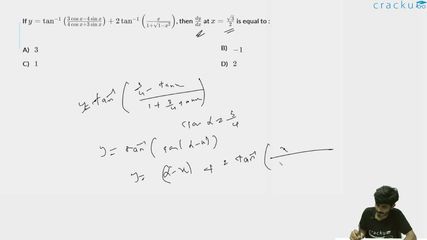
If $$y = \tan^{-1}\left(\frac{3\cos x - 4\sin x}{4\cos x + 3\sin x}\right) + 2\tan^{-1}\left(\frac{x}{1+\sqrt{1-x^2}}\right)$$, then $$\frac{dy}{dx}$$ at $$x = \frac{\sqrt{3}}{2}$$ is equal to :
Let $$y=y_1+y_2$$ where $$y_1=\tan^{-1}\!\left(\dfrac{3\cos x-4\sin x}{4\cos x+3\sin x}\right)\qquad\text{and}\qquad y_2=2\tan^{-1}\!\left(\dfrac{x}{1+\sqrt{1-x^{2}}}\right).$$
We have to find $$\dfrac{dy}{dx}$$ at $$x=\dfrac{\sqrt3}{2}\;.$$
Part I : Derivative of $$y_1$$
Divide numerator and denominator of the fraction inside $$\tan^{-1}$$ by $$\cos x$$:
$$\dfrac{3\cos x-4\sin x}{4\cos x+3\sin x}= \dfrac{3-4\tan x}{4+3\tan x}\;.$$
Let $$\alpha=\tan^{-1}\!\left(\dfrac{3}{4}\right).$$ Using the subtraction formula $$\tan(\alpha-x)=\dfrac{\tan\alpha-\tan x}{1+\tan\alpha\,\tan x},$$ we obtain
$$\tan(\alpha-x)=\dfrac{\dfrac{3}{4}-\tan x}{1+\dfrac{3}{4}\tan x} =\dfrac{3-4\tan x}{4+3\tan x}.$$
Hence $$\dfrac{3\cos x-4\sin x}{4\cos x+3\sin x}= \tan(\alpha-x).$$ Therefore
$$y_1=\tan^{-1}\!\bigl(\tan(\alpha-x)\bigr).$$
For the given point $$x=\dfrac{\sqrt3}{2}\approx0.866,$$ and $$\alpha=\tan^{-1}\!\left(\dfrac34\right)\approx0.644,$$ we have $$\alpha-x\approx-0.222\in(-\tfrac{\pi}{2},\tfrac{\pi}{2}),$$ so the principal value gives $$y_1=\alpha-x.$$ Thus $$\dfrac{dy_1}{dx}=-1.$$
Part II : Derivative of $$y_2$$
Put $$x=\sin\theta\;( -1\lt x\lt 1).$$ Then $$\sqrt{1-x^2}=\cos\theta.$$ Using the half-angle identity $$\tan\frac{\theta}{2}=\dfrac{\sin\theta}{1+\cos\theta},$$ the argument of the second $$\tan^{-1}$$ becomes
$$\dfrac{x}{1+\sqrt{1-x^{2}}}= \dfrac{\sin\theta}{1+\cos\theta}=\tan\dfrac{\theta}{2}.$$
Hence $$y_2=2\tan^{-1}\!\bigl(\tan\dfrac{\theta}{2}\bigr)=2\cdot\dfrac{\theta}{2}=\theta=\sin^{-1}x.$$
Therefore $$\dfrac{dy_2}{dx}=\dfrac{1}{\sqrt{1-x^{2}}}.$$
Value at $$x=\dfrac{\sqrt3}{2}$$
For $$x=\dfrac{\sqrt3}{2},\quad 1-x^2=1-\dfrac34=\dfrac14,\quad \sqrt{1-x^2}=\dfrac12.$$ Hence
$$\dfrac{dy_2}{dx}\Bigg|_{x=\frac{\sqrt3}{2}}=\dfrac{1}{1/2}=2.$$
Total derivative
$$\dfrac{dy}{dx}=\dfrac{dy_1}{dx}+\dfrac{dy_2}{dx}=(-1)+2=1.$$
Thus the required value is $$1.$$
Option C which is: $$1$$
Was this solution helpful?
Click on the Email ☝️ to Watch the Video Solution
Create a FREE account and get:
_1.webp)

Educational materials for JEE preparation

Ask our AI anything

AI can make mistakes. Please verify important information.
AI can make mistakes. Please verify important information.


