
Join Our JEE Preparation Group
Prep with like-minded aspirants; Get access to free daily tests and study material.
Sign in
Please select an account to continue using cracku.in
↓ →
Join Our JEE Preparation Group
Prep with like-minded aspirants; Get access to free daily tests and study material.
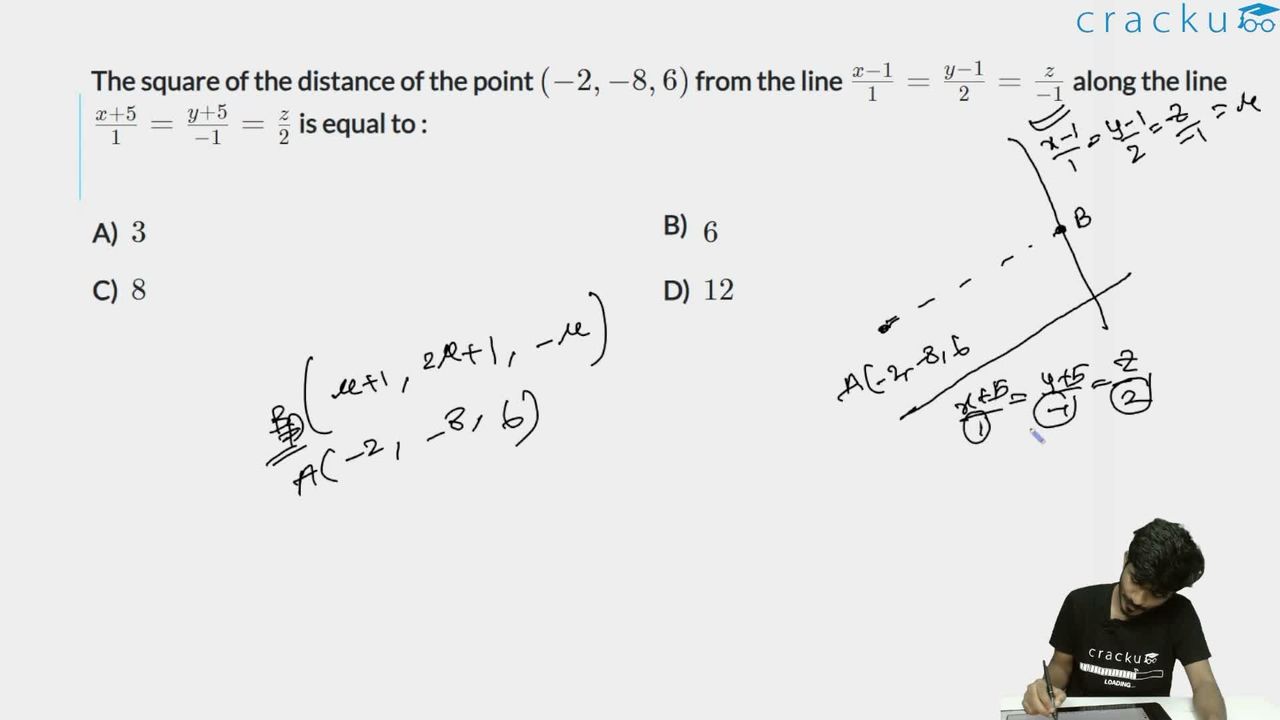
The square of the distance of the point $$(-2, -8, 6)$$ from the line $$\frac{x-1}{1} = \frac{y-1}{2} = \frac{z}{-1}$$ along the line $$\frac{x+5}{1} = \frac{y+5}{-1} = \frac{z}{2}$$ is equal to :
Let the required foot of the “oblique” perpendicular be the point $$Q$$ on the first line
$$\frac{x-1}{1}=\frac{y-1}{2}=\frac{z}{-1}\;,$$ whose direction vector is $$\mathbf{a}=(1,2,-1).$$ Parameterise this line as $$Q(1+t,\;1+2t,\;-t),\qquad t\in\mathbb{R}.$$
We must reach this line from the given point $$P(-2,-8,6)$$ along the second line
$$\frac{x+5}{1}=\frac{y+5}{-1}=\frac{z}{2},$$ whose direction vector is $$\mathbf{b}=(1,-1,2).$$ Hence the vector $$\overrightarrow{QP}=\mathbf{PQ}$$ has to be a scalar multiple of $$\mathbf{b}$$:
$$\overrightarrow{PQ}=P-Q=\lambda\mathbf{b},\qquad\lambda\in\mathbb{R}.$$
Write $$\overrightarrow{PQ}$$ component-wise:
$$P-Q=(-2-(1+t),\,-8-(1+2t),\,6-(-t))=(-3-t,\,-9-2t,\,6+t).$$
Equate each component to $$\lambda(1,-1,2)$$:
$$\begin{aligned} -3-t &= \lambda\quad &-(1)\\ -9-2t &= -\lambda\quad &-(2)\\ 6+t &= 2\lambda\quad &-(3) \end{aligned}$$
From $$(1)$$, $$\lambda=-3-t.$$ Insert this in $$(2)$$:
$$-9-2t = -(-3-t)=3+t\;\;\Longrightarrow\;\;-12-3t=0\;\;\Longrightarrow\;\;t=-4.$$
Therefore $$\lambda=-3-(-4)=1.$$ Check with $$(3)$$: $$6+t=6-4=2=2\lambda,\;$$ so all three equations agree.
Thus $$\overrightarrow{PQ}=1\cdot\mathbf{b}=\mathbf{b},$$ so the distance is
$$|PQ| = |\mathbf{b}| = \sqrt{1^{2}+(-1)^{2}+2^{2}}=\sqrt{6}.$$
The question asks for the square of this distance:
$$|PQ|^{2} = (\sqrt{6})^{2}=6.$$
Option B which is: 6
Was this solution helpful?
Click on the Email ☝️ to Watch the Video Solution
Create a FREE account and get:
_1.webp)

Educational materials for JEE preparation

Ask our AI anything

AI can make mistakes. Please verify important information.
AI can make mistakes. Please verify important information.


