
Join Our JEE Preparation Group
Prep with like-minded aspirants; Get access to free daily tests and study material.
Sign in
Please select an account to continue using cracku.in
↓ →
Join Our JEE Preparation Group
Prep with like-minded aspirants; Get access to free daily tests and study material.
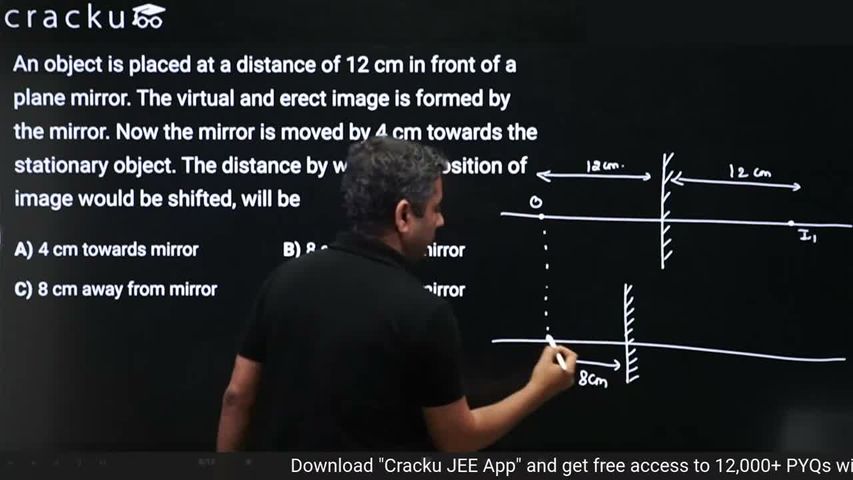
An object is placed at a distance of 12 cm in front of a plane mirror. The virtual and erect image is formed by the mirror. Now the mirror is moved by 4 cm towards the stationary object. The distance by which the position of image would be shifted, will be
An object is 12 cm in front of a plane mirror. The mirror moves 4 cm towards the stationary object. Find the shift in image position.
To begin,
For a plane mirror, the image is as far behind the mirror as the object is in front. Initially, the image is 12 cm behind the mirror, i.e., 24 cm from the object.
Next,
When the mirror moves 4 cm towards the object, the new object distance = $$12 - 4 = 8$$ cm.
The new image is 8 cm behind the new mirror position.
From this,
Original image position (from a fixed reference, say the object): 24 cm from object (or 12 cm behind mirror's original position).
New image position: The new mirror is at 8 cm from object. Image is 8 cm behind this new position = 16 cm from object.
Shift in image = $$24 - 16 = 8$$ cm towards the mirror (or towards the object).
Alternatively: When mirror shifts by $$d$$, image shifts by $$2d = 2 \times 4 = 8$$ cm in the same direction as the mirror (towards the object/mirror).
The correct answer is Option B: 8 cm towards mirror.
Click on the Email ☝️ to Watch the Video Solution
Create a FREE account and get:
_1.webp)

Educational materials for JEE preparation

Ask our AI anything

AI can make mistakes. Please verify important information.
AI can make mistakes. Please verify important information.


