
Join Our JEE Preparation Group
Prep with like-minded aspirants; Get access to free daily tests and study material.
Sign in
Please select an account to continue using cracku.in
↓ →
Join Our JEE Preparation Group
Prep with like-minded aspirants; Get access to free daily tests and study material.
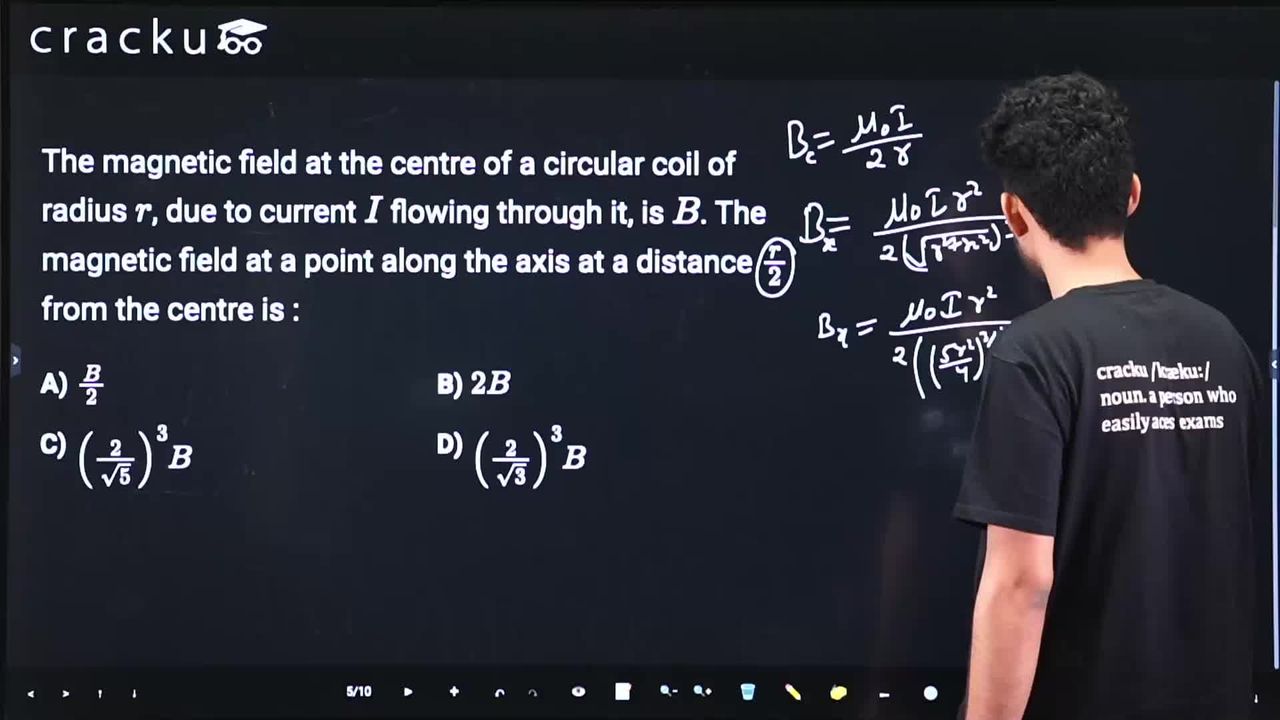
The magnetic field at the centre of a circular coil of radius $$r$$, due to current $$I$$ flowing through it, is $$B$$. The magnetic field at a point along the axis at a distance $$\frac{r}{2}$$ from the centre is :
We are given that the magnetic field at the centre of a circular coil of radius $$r$$ carrying current $$I$$ is $$B$$, and we need to find the magnetic field at a point on the axis at distance $$\frac{r}{2}$$ from the centre.
The magnetic field at the centre of a circular coil is $$ B_{centre} = \frac{\mu_0 I}{2r} = B $$ and on the axis at a distance $$x$$ from the centre it is $$ B_{axis} = \frac{\mu_0 I r^2}{2(r^2 + x^2)^{3/2}} $$. Substituting $$x = \frac{r}{2}$$ gives $$ B_{axis} = \frac{\mu_0 I r^2}{2\left(r^2 + \frac{r^2}{4}\right)^{3/2}} = \frac{\mu_0 I r^2}{2\left(\frac{5r^2}{4}\right)^{3/2}} $$. Since $$ \left(\frac{5r^2}{4}\right)^{3/2} = \frac{(5)^{3/2}}{(4)^{3/2}} \cdot r^3 = \frac{5\sqrt{5}}{8} \cdot r^3 $$, it follows that $$ B_{axis} = \frac{\mu_0 I r^2}{2 \cdot \frac{5\sqrt{5}}{8} \cdot r^3} = \frac{\mu_0 I}{2r} \cdot \frac{8}{5\sqrt{5}} = B \cdot \frac{8}{5\sqrt{5}} $$. Noting $$ \frac{8}{5\sqrt{5}} = \frac{2^3}{(\sqrt{5})^2 \cdot \sqrt{5}} = \frac{2^3}{(\sqrt{5})^3} = \left(\frac{2}{\sqrt{5}}\right)^3 $$, we conclude
$$ B_{axis} = \left(\frac{2}{\sqrt{5}}\right)^3 B $$
The correct answer is Option C.
Was this solution helpful?
Click on the Email ☝️ to Watch the Video Solution
Create a FREE account and get:
_1.webp)

Educational materials for JEE preparation

Ask our AI anything

AI can make mistakes. Please verify important information.
AI can make mistakes. Please verify important information.
