
Join Our JEE Preparation Group
Prep with like-minded aspirants; Get access to free daily tests and study material.
Sign in
Please select an account to continue using cracku.in
↓ →
Join Our JEE Preparation Group
Prep with like-minded aspirants; Get access to free daily tests and study material.
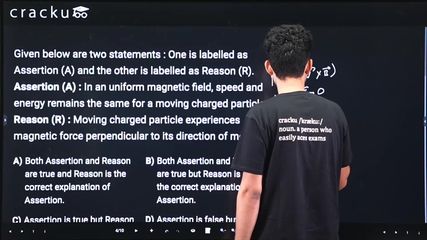
Given below are two statements : One is labelled as Assertion (A) and the other is labelled as Reason (R).
Assertion (A) : In an uniform magnetic field, speed and energy remains the same for a moving charged particle.
Reason (R) : Moving charged particle experiences magnetic force perpendicular to its direction of motion.
Assertion (A): In a uniform magnetic field, speed and energy remain the same for a moving charged particle. Reason (R): A moving charged particle experiences a magnetic force perpendicular to its direction of motion.
The magnetic force on a charged particle is $$\vec{F} = q(\vec{v} \times \vec{B})$$, which is always perpendicular to the velocity $$\vec{v}$$. Since the force is perpendicular to the velocity, the work done by the magnetic force is:
$$ W = \vec{F} \cdot \vec{v} \, dt = 0 $$
Since no work is done, kinetic energy $$\frac{1}{2}mv^2$$ remains constant and therefore the speed remains constant. Thus, the Assertion is true.
The cross product $$\vec{v} \times \vec{B}$$ is indeed perpendicular to $$\vec{v}$$, so the magnetic force is perpendicular to the direction of motion. Hence, the Reason is true.
It is precisely because the magnetic force is perpendicular to the velocity that no work is done on the particle, which directly leads to the speed and kinetic energy remaining constant. Therefore, the Reason is the correct explanation of the Assertion.
Therefore, the correct answer is Option A: Both Assertion and Reason are true and Reason is the correct explanation of Assertion.
Was this solution helpful?
Click on the Email ☝️ to Watch the Video Solution
Create a FREE account and get:
_1.webp)

Educational materials for JEE preparation

Ask our AI anything

AI can make mistakes. Please verify important information.
AI can make mistakes. Please verify important information.
