
Join Our JEE Preparation Group
Prep with like-minded aspirants; Get access to free daily tests and study material.
Sign in
Please select an account to continue using cracku.in
↓ →
Join Our JEE Preparation Group
Prep with like-minded aspirants; Get access to free daily tests and study material.
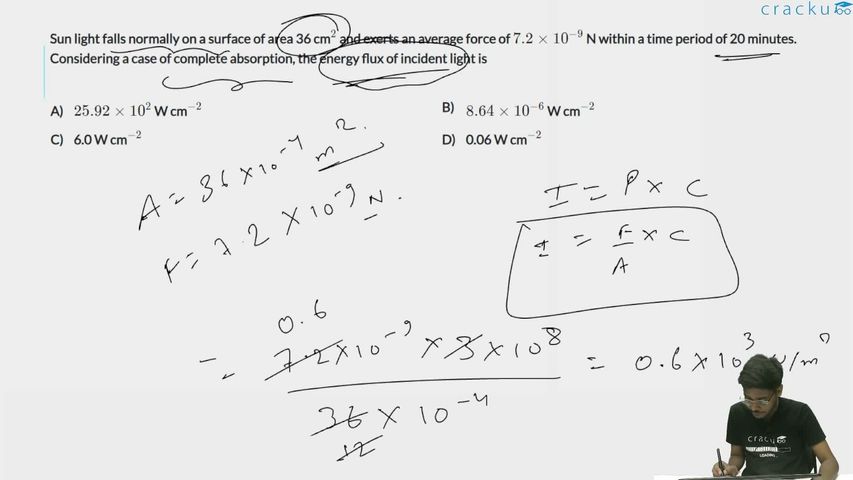
Sun light falls normally on a surface of area 36 cm$$^2$$ and exerts an average force of $$7.2 \times 10^{-9}$$ N within a time period of 20 minutes. Considering a case of complete absorption, the energy flux of incident light is
We are given that sunlight falls normally on a surface of area $$A = 36 \text{ cm}^2$$ and exerts an average force of $$F = 7.2 \times 10^{-9}$$ N. The light is completely absorbed.
For complete absorption, the radiation pressure is $$P = \frac{I}{c}$$, where $$I$$ is the intensity (energy flux) and $$c$$ is the speed of light. Also, $$F = P \times A$$, so $$F = \frac{I \times A}{c}$$.
Solving for the intensity: $$I = \frac{Fc}{A}$$.
Substituting values (using $$A = 36 \times 10^{-4} \text{ m}^2$$ and $$c = 3 \times 10^8 \text{ m/s}$$):
$$I = \frac{7.2 \times 10^{-9} \times 3 \times 10^8}{36 \times 10^{-4}} = \frac{2.16}{36 \times 10^{-4}} = \frac{2.16}{3.6 \times 10^{-3}} = 600 \text{ W/m}^2$$.
Now converting to W cm$$^{-2}$$: since $$1 \text{ m}^2 = 10^4 \text{ cm}^2$$, we get $$I = \frac{600}{10^4} = 0.06 \text{ W cm}^{-2}$$.
Hence, the correct answer is Option D.
Was this solution helpful?
Click on the Email ☝️ to Watch the Video Solution
Create a FREE account and get:
_1.webp)

Educational materials for JEE preparation

Ask our AI anything

AI can make mistakes. Please verify important information.
AI can make mistakes. Please verify important information.
