
Join Our JEE Preparation Group
Prep with like-minded aspirants; Get access to free daily tests and study material.
Sign in
Please select an account to continue using cracku.in
↓ →
Join Our JEE Preparation Group
Prep with like-minded aspirants; Get access to free daily tests and study material.
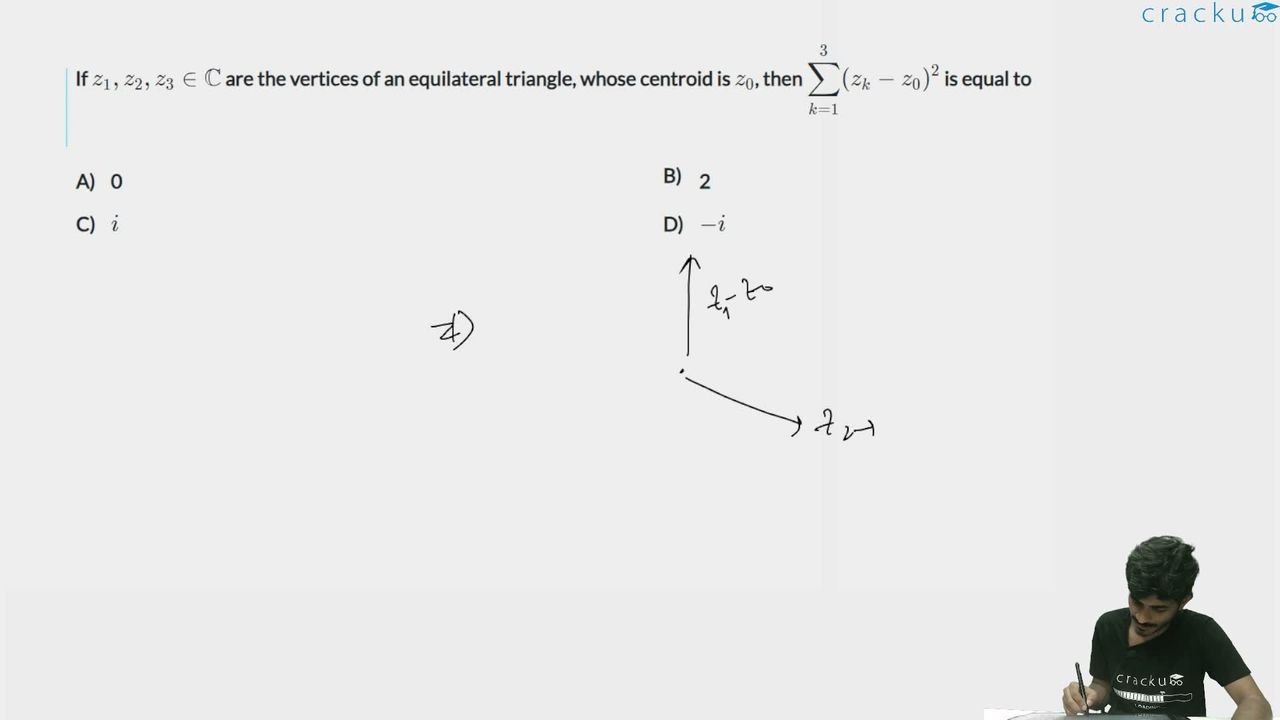
If $$z_1, z_2, z_3 \in \mathbb{C}$$ are the vertices of an equilateral triangle, whose centroid is $$z_0$$, then $$\displaystyle\sum_{k=1}^{3} (z_k - z_0)^2$$ is equal to
Given that $$z_1, z_2, z_3$$ are vertices of an equilateral triangle with centroid $$z_0$$.
The centroid is $$z_0 = \dfrac{z_1 + z_2 + z_3}{3}$$.
For an equilateral triangle with centroid at $$z_0$$, the vertices can be written as $$z_k = z_0 + r \cdot e^{i(\theta + 2\pi(k-1)/3)}$$ for $$k = 1, 2, 3$$, where $$r$$ is the circumradius.
So $$z_k - z_0 = r \cdot e^{i(\theta + 2\pi(k-1)/3)}$$.
Therefore: $$\displaystyle\sum_{k=1}^{3} (z_k - z_0)^2 = r^2 \displaystyle\sum_{k=1}^{3} e^{2i(\theta + 2\pi(k-1)/3)}$$
$$= r^2 e^{2i\theta} \displaystyle\sum_{k=1}^{3} e^{4\pi i(k-1)/3}$$
$$= r^2 e^{2i\theta} \left(1 + e^{4\pi i/3} + e^{8\pi i/3}\right)$$
Now, $$e^{4\pi i/3}$$ and $$e^{8\pi i/3} = e^{2\pi i/3}$$ (since $$8\pi/3 - 2\pi = 2\pi/3$$) are the cube roots of unity (other than 1 shifted). Specifically, $$1 + e^{2\pi i/3} + e^{4\pi i/3} = 0$$ (sum of cube roots of unity).
Therefore, $$\displaystyle\sum_{k=1}^{3} (z_k - z_0)^2 = r^2 e^{2i\theta} \cdot 0 = 0$$.
Hence, the correct answer is Option A.
Click on the Email ☝️ to Watch the Video Solution
Create a FREE account and get:
_1.webp)

Educational materials for JEE preparation

Ask our AI anything

AI can make mistakes. Please verify important information.
AI can make mistakes. Please verify important information.


