
Join Our JEE Preparation Group
Prep with like-minded aspirants; Get access to free daily tests and study material.
Sign in
Please select an account to continue using cracku.in
↓ →
Join Our JEE Preparation Group
Prep with like-minded aspirants; Get access to free daily tests and study material.
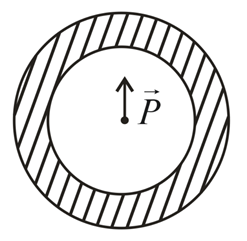
Shown in the figure is a shell made of a conductor. It has inner radius a and outer radius b, and carries charge Q. At its centre a dipole $$\vec{p}$$ is placed as shown then:
Given:
Conducting spherical shell (inner radius a, outer radius b) carrying total charge Q.
$$An\ electric\ dipole\ P\ is\ placed\ at\ the\ centre$$
Concept Used:
Analysis:
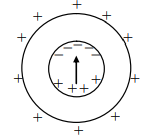
The dipole induces charges on the inner surface, but since a dipole has no net charge,
Total induced charge on inner surface=0The conductor already has total charge Q, so:
Charge on outer surface=QConclusion:
Final Answer:
Outer surface charge =Q, Inner surface net charge =0
So for any observer outside the shell, the resultant electric field is due to Q uniformly distributed on the outer surface only
Create a FREE account and get:
_1.webp)

Educational materials for JEE preparation

Ask our AI anything

AI can make mistakes. Please verify important information.
AI can make mistakes. Please verify important information.


