
Join Our JEE Preparation Group
Prep with like-minded aspirants; Get access to free daily tests and study material.
Sign in
Please select an account to continue using cracku.in
↓ →
Join Our JEE Preparation Group
Prep with like-minded aspirants; Get access to free daily tests and study material.
Let $$\alpha$$ and $$\beta$$ be the distinct roots of the equation $$x^2 + x - 1 = 0$$. Consider the set $$T = \{1, \alpha, \beta\}$$. For a $$3 \times 3$$ matrix $$M = (a_{ij})_{3 \times 3}$$, define $$R_i = a_{i1} + a_{i2} + a_{i3}$$ and $$C_j = a_{1j} + a_{2j} + a_{3j}$$ for $$i = 1, 2, 3$$ and $$j = 1, 2, 3$$.
Match each entry in List-I to the correct entry in List-II.
| List-I | List-II | ||
|---|---|---|---|
| (P) | The number of matrices $$M = (a_{ij})_{3 \times 3}$$ with all entries in $$T$$ such that $$R_i = C_j = 0$$ for all $$i, j$$ is | (1) | 1 |
| (Q) | The number of symmetric matrices $$M = (a_{ij})_{3 \times 3}$$ with all entries in $$T$$ such that $$C_j = 0$$ for all $$j$$ is | (2) | 12 |
| (R) | Let $$M = (a_{ij})_{3 \times 3}$$ be a skew symmetric matrix such that $$a_{ij} \in T$$ for $$i \gt j$$. Then the number of elements in the set $$\left\{\begin{pmatrix} x \\ y \\ z \end{pmatrix} : x, y, z \in R, M\begin{pmatrix} x \\ y \\ z \end{pmatrix} = \begin{pmatrix} a_{12} \\ 0 \\ -a_{23} \end{pmatrix}\right\}$$ is | (3) | Infinite |
| (S) | Let $$M = (a_{ij})_{3 \times 3}$$ be a matrix with all entries in $$T$$ such that $$R_i = 0$$ for all $$i$$. Then the absolute value of the determinant of $$M$$ is | (4) | 6 |
| (5) | 0 |
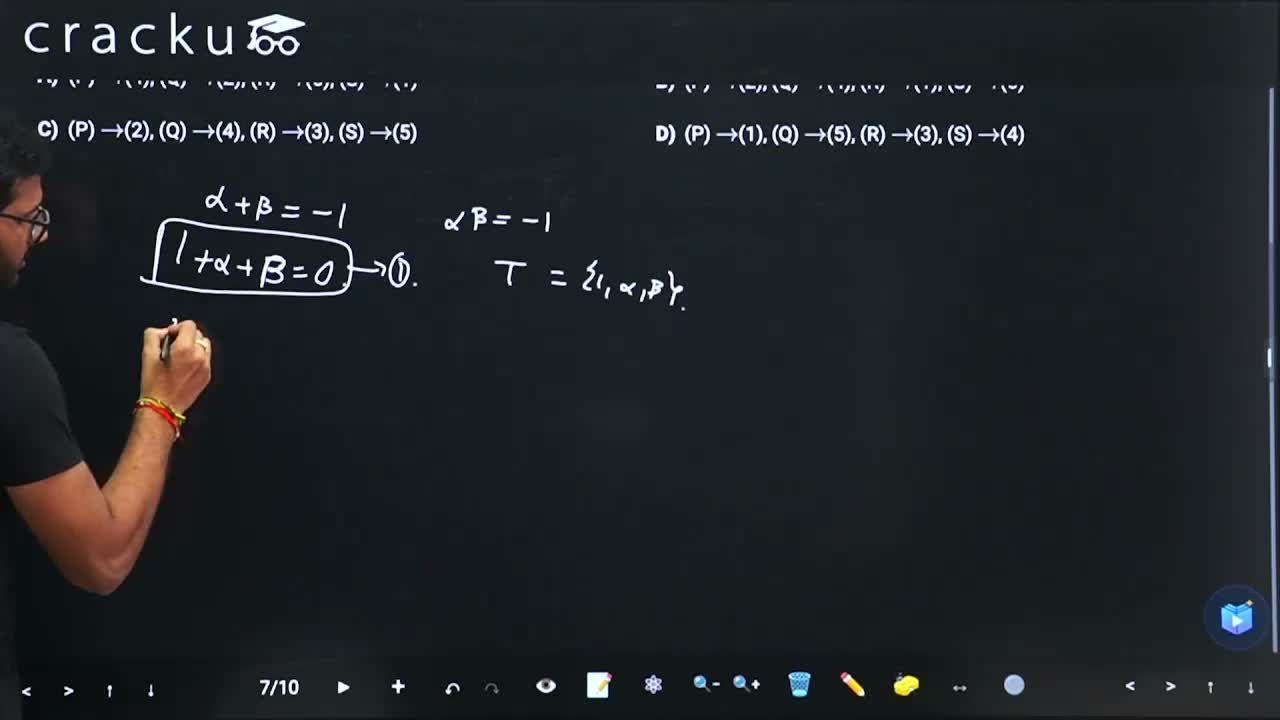
The quadratic $$x^{2}+x-1=0$$ has distinct roots $$\alpha,\,\beta$$ satisfying the Vieta relations $$\alpha+\beta=-1$$ and $$\alpha\beta=-1$$. Consequently $$1+\alpha+\beta=0$$, a fact that will be used repeatedly.
Case P (row and column sums zero, no symmetry condition):
Let a row be $$(t_{1},t_{2},t_{3})$$ with each $$t_{k}\in T=\{1,\alpha,\beta\}$$ and $$t_{1}+t_{2}+t_{3}=0$$. Write the counts of $$1,\alpha,\beta$$ in the row as $$(n_{1},n_{\alpha},n_{\beta})$$. Then $$n_{1}+n_{\alpha}+n_{\beta}=3$$ and $$n_{1}-n_{\beta}+\alpha\!\left(n_{\alpha}-n_{\beta}\right)=0.$$ Since $$1,\alpha$$ are linearly independent over $$\mathbb{Q}$$, we must have $$n_{1}=n_{\alpha}=n_{\beta}=1.$$ Thus every row is a permutation of $$(1,\alpha,\beta)$$, and the same holds for every column.
A $$3\times3$$ array in which each row and column contains every symbol exactly once is a Latin square of order $$3$$. For a fixed first row there are exactly $$2$$ such squares; there are $$3!=6$$ possible first rows, giving $$6\times2=12$$ matrices.
Therefore $$P\rightarrow 12\;.$$
Case Q (symmetric matrices with column sums zero):
Because the matrix is symmetric, row sums equal column sums, so every row also sums to $$0$$ and hence is a permutation of $$(1,\alpha,\beta)$$. Let the diagonal be $$(d_{1},d_{2},d_{3})$$. If any two diagonal entries were equal, the corresponding column would repeat that entry, violating the “one-of-each’’ rule; therefore $$d_{1},d_{2},d_{3}$$ are all distinct. There are $$3!=6$$ ways to choose this ordered diagonal.
Once the diagonal is fixed, the $$(i,j)$$-entry for $$i\lt j$$ must be the unique element of $$T$$ different from $$d_{i}$$ and $$d_{j}$$, and symmetry forces the $$(j,i)$$-entry to be the same. Hence the rest of the matrix is determined uniquely.
Thus there are $$6$$ symmetric matrices, so $$Q\rightarrow 6\;.$$
Case R (skew-symmetric matrix and a linear system):
A $$3\times3$$ skew-symmetric matrix is of the form $$M=\begin{pmatrix}0&b&c\\-b&0&d\\-c&-d&0\end{pmatrix},$$ where $$b,c,d\in T$$ (because the entries below the diagonal are required to lie in $$T$$). The given system is $$M\begin{pmatrix}x\\y\\z\end{pmatrix}= \begin{pmatrix}b\\0\\-d\end{pmatrix}.$$
The second column of $$M$$ is $$\bigl[b,\,0,\,-d\bigr]^{\!T}$$, exactly the required right-hand side. Since the rank of a $$3\times3$$ skew-symmetric matrix is $$0$$ or $$2$$ (it is never full), this right-hand side is always in the column space, so the system is consistent. Because the rank is $$2$$, the solution space has dimension $$3-2=1$$, containing infinitely many vectors.
Hence the set in question is infinite, so $$R\rightarrow \text{Infinite}\;.$$
Case S (row sums zero, determinant):
Each row sums to $$0$$, so (as in Case P) every row is a permutation of $$(1,\alpha,\beta)$$. Thus every row lies in the plane $$x+y+z=0$$, a $$2$$-dimensional subspace of $$\mathbb{R}^{3}$$. Three vectors confined to a plane are necessarily linearly dependent, so the matrix is singular and its determinant is $$0$$.
Therefore $$S\rightarrow 0\;.$$
Collecting the results:
(P) $$\to$$ 12 (Option 2), (Q) $$\to$$ 6 (Option 4), (R) $$\to$$ Infinite (Option 3), (S) $$\to$$ 0 (Option 5)
The option that matches this combination is
Option C: (P) → (2), (Q) → (4), (R) → (3), (S) → (5).
Click on the Email ☝️ to Watch the Video Solution
Create a FREE account and get:
_1.webp)

Educational materials for JEE preparation

Ask our AI anything

AI can make mistakes. Please verify important information.
AI can make mistakes. Please verify important information.


