
Join Our JEE Preparation Group
Prep with like-minded aspirants; Get access to free daily tests and study material.
Sign in
Please select an account to continue using cracku.in
↓ →
Join Our JEE Preparation Group
Prep with like-minded aspirants; Get access to free daily tests and study material.
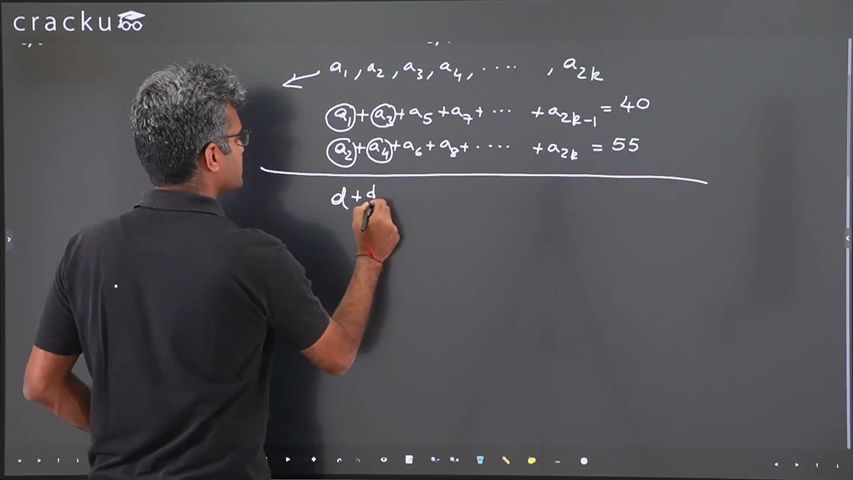
Suppose that the number of terms in an A.P is $$2k, k \in N$$. If the sum of all odd terms of the A.P. is 40 , the sum of all even terms is 55 and the last term of the A.P. exceeds the first term by 27, then k is equal to :
The arithmetic progression has a total of $$2K$$ terms, where, $$K$$ is natural number.
Let the first term of the A.P be $$a$$ and the common difference be $$d$$.
Last term of the A.P = $$a+\left(2K-1\right)d$$
Difference between the last term and the first term of the A.P = $$a+\left(2K-1\right)d\ -a=\left(2K-1\right)d$$
Difference = 27 (given)
$$\left(2K-1\right)d=27$$ $$\longrightarrow\ i$$
Now, it is given that the sum of all the odd and even terms are 40 and 55 respectively.
Odd terms : 1st term, 3rd term, 5th term, ....., $$(2K-1)$$th term
Odd terms : $$a,\ (a+2d),\ (a+4d),\ .....,\ (a+(2K-2)d)$$
Total number of odd terms = $$K$$
Sum of all the odd terms = $$\dfrac{K}{2}\times\left(a+\left(a+\left(2K-2\right)d\right)\right)=40$$
$$\dfrac{K}{2}\times\left(2a+\left(2K-1\right)d-d\right)=40$$
$$\dfrac{K}{2}\times\left(2a+27-d\right)=40$$ $$\longrightarrow\ ii$$
Even terms : 2nd term, 4th term, 6th term, ....., $$(2K)$$th term
Even terms : $$(a+d),\ (a+3d),\ (a+5d),\ .....,\ (a+(2K-1)d)$$
Total number of even terms = $$K$$
Sum of all the even terms = $$\dfrac{K}{2}\times\left(\left(a+d\right)+\left(a+\left(2K-1\right)d\right)\right)=55$$
$$\dfrac{K}{2}\times\left(2a+27+d\right)=55$$ $$\longrightarrow\ iii$$
Divide equation $$iii$$ by equation $$ii$$,
$$\dfrac{\left(2a+27\right)+d}{\left(2a+27\right)-d}=\dfrac{55}{40}=\dfrac{11}{8}$$
$$8\left(2a+27\right)+8d=11\left(2a+27\right)-11d$$
$$3\left(2a+27\right)=19d$$
$$2a+27=\dfrac{19d}{3}$$ $$\longrightarrow\ iv$$
Insert the value of $$(2a+27)$$ in equation $$ii$$ from equation $$iv$$,
$$\dfrac{K}{2}\times\left(\dfrac{19d}{3}-d\right)=40$$
$$\dfrac{K}{2}\times\left(\dfrac{16d}{3}\right)=40$$
$$Kd=15$$ $$\longrightarrow\ v$$
Insert the value of $$d$$ from equation $$v$$ to equation $$i$$ to find the value of $$K$$.
$$\left(2K-1\right)\times\dfrac{15}{K}=27$$
$$\left(2K-1\right)\times5=9K$$
$$10K-5=9K$$
$$K=5$$
Hence, the value of $$K$$ is 5.
$$\therefore\ $$ The required answer is B.
Was this solution helpful?
Click on the Email ☝️ to Watch the Video Solution
Create a FREE account and get:
_1.webp)

Educational materials for JEE preparation

Ask our AI anything

AI can make mistakes. Please verify important information.
AI can make mistakes. Please verify important information.
