
Join Our JEE Preparation Group
Prep with like-minded aspirants; Get access to free daily tests and study material.
Sign in
Please select an account to continue using cracku.in
↓ →
Join Our JEE Preparation Group
Prep with like-minded aspirants; Get access to free daily tests and study material.
Let A = {1, 2, 3, 4} and B = {1, 4, 9, 16}. Then the number of many-one functions $$f:A \rightarrow B$$ such that $$1 \in f(A)$$ is equal to :
We are given sets $$A = \{1, 2, 3, 4\}$$ and $$B = \{1, 4, 9, 16\}$$ and asked to determine the number of many-one functions $$f: A \to B$$ such that $$1 \in f(A)$$. By definition, a many-one function is not injective, which means at least two elements of $$A$$ are mapped to the same element of $$B$$.
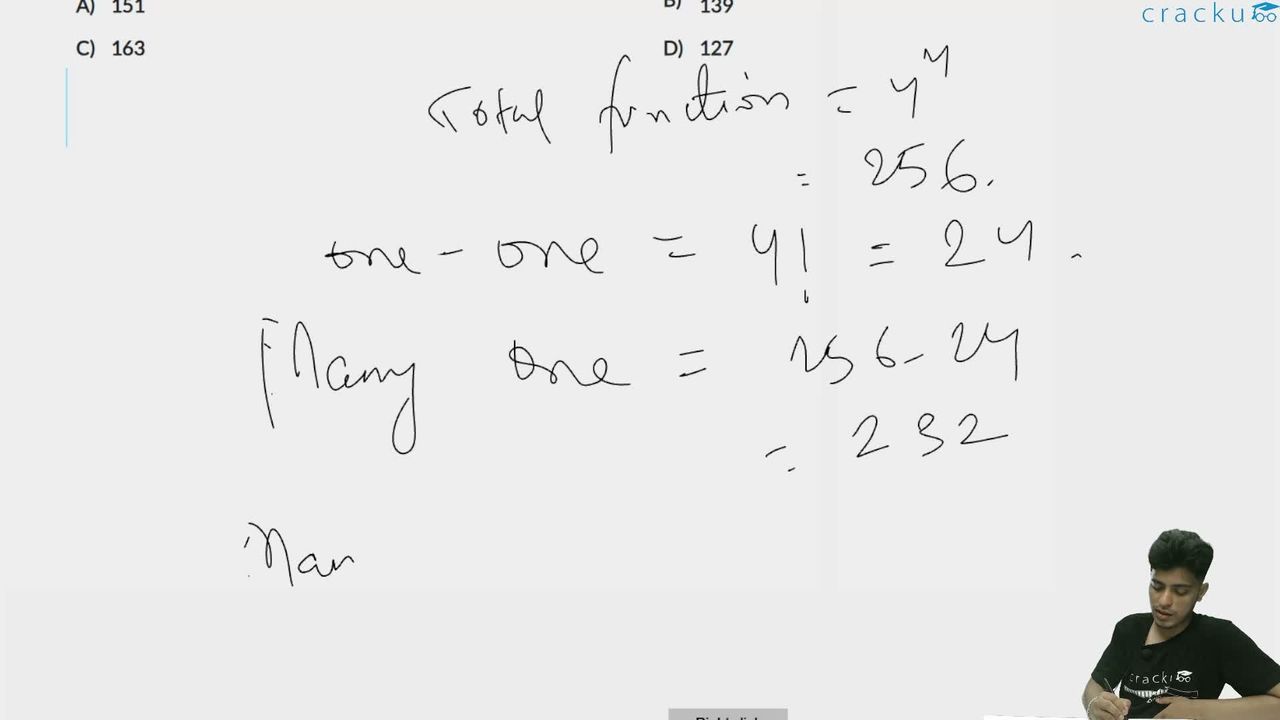
First, the total number of functions from $$A$$ to $$B$$ is found by noting that each of the four elements of $$A$$ can map to any of the four elements of $$B$$, yielding $$4^4 = 256$$ total functions. The number of injective functions from $$A$$ to $$B$$ is the number of one-to-one correspondences between two 4-element sets, namely $$4! = 24$$. Therefore, the number of many-one functions from $$A$$ to $$B$$ is $$256 - 24 = 232$$.
Next, we exclude those many-one functions for which $$1 \notin f(A)$$. In that case, the function’s image must lie entirely in the set $$\{4, 9, 16\}$$, which has three elements. Hence there are $$3^4 = 81$$ such functions. Since $$|A| = 4 > 3 = |\{4, 9, 16\}|$$, none of these functions can be injective, so all 81 are many-one. Subtracting this quantity from $$232$$ gives the number of many-one functions for which $$1 \in f(A)$$, namely $$232 - 81 = 151$$.
Therefore, the required number of many-one functions satisfying the condition is $$151$$.
Was this solution helpful?
Click on the Email ☝️ to Watch the Video Solution
Create a FREE account and get:
_1.webp)

Educational materials for JEE preparation

Ask our AI anything

AI can make mistakes. Please verify important information.
AI can make mistakes. Please verify important information.
