
Join Our JEE Preparation Group
Prep with like-minded aspirants; Get access to free daily tests and study material.
Sign in
Please select an account to continue using cracku.in
↓ →
Join Our JEE Preparation Group
Prep with like-minded aspirants; Get access to free daily tests and study material.
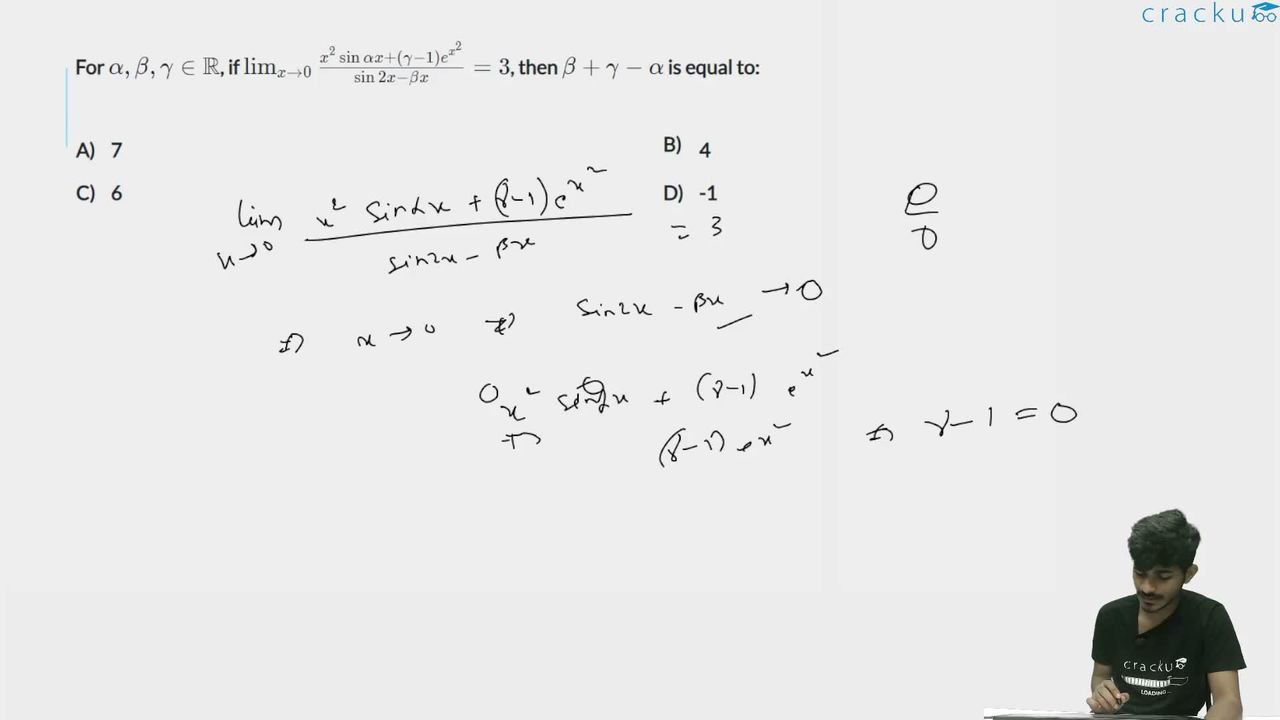
For $$\alpha, \beta, \gamma \in \mathbb{R}$$, if $$\lim_{x \to 0} \frac{x^2 \sin \alpha x + (\gamma - 1)e^{x^2}}{\sin 2x - \beta x} = 3$$, then $$\beta + \gamma - \alpha$$ is equal to:
We need the limit
$$L=\lim_{x\to 0}\frac{x^{2}\sin \alpha x+(\gamma-1)e^{x^{2}}}{\sin 2x-\beta x}$$
to be equal to $$3$$. Use the Maclaurin (Taylor) series of the standard functions about $$x=0$$:
$$\sin kx = kx-\frac{(kx)^{3}}{3!}+O(x^{5})\qquad (k\in\mathbb{R})$$
$$e^{x^{2}} = 1+x^{2}+\frac{x^{4}}{2}+O(x^{6})$$
Step 1: Expand the numerator
$$x^{2}\sin \alpha x = x^{2}\left(\alpha x-\frac{\alpha^{3}x^{3}}{6}+O(x^{5})\right) = \alpha x^{3}-\frac{\alpha^{3}}{6}x^{5}+O(x^{7})$$
$$(\gamma-1)e^{x^{2}} = (\gamma-1)\!\left(1+x^{2}+O(x^{4})\right) = (\gamma-1)+(\gamma-1)x^{2}+O(x^{4})$$
Hence
Numerator $$= (\gamma-1)+(\gamma-1)x^{2}+\alpha x^{3}+O(x^{4})$$
Step 2: Expand the denominator
$$\sin 2x = 2x-\frac{(2x)^{3}}{3!}+O(x^{5}) = 2x-\frac{4}{3}x^{3}+O(x^{5})$$
Therefore
Denominator $$= \left(2x-\frac{4}{3}x^{3}+O(x^{5})\right)-\beta x = (2-\beta)x-\frac{4}{3}x^{3}+O(x^{5})$$
Step 3: Enforce that the limit is finite
For $$L$$ to exist finitely, the lowest‐degree (non-zero) power of $$x$$ in the numerator must match that in the denominator.
The denominator’s lowest power is $$x$$ unless $$2-\beta=0$$. The numerator currently has the constant term $$(\gamma-1)$$.
Set the constant term to zero:
$$(\gamma-1)=0\;\;\Longrightarrow\;\;\gamma=1$$
With $$\gamma=1$$ the numerator starts from $$\alpha x^{3}+O(x^{4})$$, i.e. order $$x^{3}$$. To make the denominator also start from order $$x^{3}$$ we need
$$(2-\beta)=0\;\;\Longrightarrow\;\;\beta=2$$
Step 4: Calculate the limit with these values
Denominator (with $$\beta=2$$):
$$\sin 2x-2x = -\frac{4}{3}x^{3}+O(x^{5})$$
Numerator (with $$\gamma=1$$):
$$x^{2}\sin \alpha x = \alpha x^{3}+O(x^{5})$$
Hence
$$L=\lim_{x\to 0}\frac{\alpha x^{3}+O(x^{5})}{-\dfrac{4}{3}x^{3}+O(x^{5})}=\lim_{x\to 0}\frac{\alpha+O(x^{2})}{-\dfrac{4}{3}+O(x^{2})}=-\frac{3}{4}\alpha$$
Given that $$L=3$$, we get
$$-\frac{3}{4}\alpha = 3 \;\;\Longrightarrow\;\; \alpha = -4$$
Step 5: Compute $$\beta+\gamma-\alpha$$
$$\beta+\gamma-\alpha = 2+1-(-4)=2+1+4=7$$
Therefore, $$\beta+\gamma-\alpha = 7$$. The correct choice is Option A.
Was this solution helpful?
Click on the Email ☝️ to Watch the Video Solution
Create a FREE account and get:
_1.webp)

Educational materials for JEE preparation

Ask our AI anything

AI can make mistakes. Please verify important information.
AI can make mistakes. Please verify important information.


