
Join Our JEE Preparation Group
Prep with like-minded aspirants; Get access to free daily tests and study material.
Sign in
Please select an account to continue using cracku.in
↓ →
Join Our JEE Preparation Group
Prep with like-minded aspirants; Get access to free daily tests and study material.
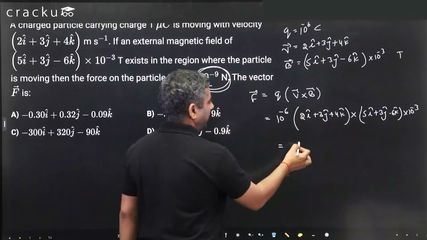
A charged particle carrying charge 1 $$\mu C$$ is moving with velocity $$\left(2\hat{i} + 3\hat{j} + 4\hat{k}\right)$$ m s$$^{-1}$$. If an external magnetic field of $$\left(5\hat{i} + 3\hat{j} - 6\hat{k}\right) \times 10^{-3}$$ T exists in the region where the particle is moving then the force on the particle is $$\vec{F} \times 10^{-9}$$ N. The vector $$\vec{F}$$ is:
We need the magnetic force on a moving charge. The magnetic (Lorentz) force formula is stated first:
$$\vec{F}=q\,\left(\vec{v}\times\vec{B}\right).$$
Here the charge is $$q = 1\,\mu\text{C}=1\times10^{-6}\,\text{C},$$ the velocity is $$\vec{v}=2\hat i+3\hat j+4\hat k\;\text{m s}^{-1},$$ and the magnetic field is $$\vec{B}=\left(5\hat i+3\hat j-6\hat k\right)\times10^{-3}\,\text{T}.$$
We first evaluate the cross product $$\vec{v}\times\vec{B}.$$ Writing out the determinant:
$$$ \vec{v}\times\vec{B}= \begin{vmatrix} \hat i & \hat j & \hat k\\[4pt] 2 & 3 & 4\\[4pt] 5\times10^{-3} & 3\times10^{-3} & -6\times10^{-3} \end{vmatrix}. $$$
Because every component of $$\vec{B}$$ already contains the common factor $$10^{-3},$$ we keep that factor outside for clarity and perform the determinant with the numerical parts $$5,\,3,\, -6$$ only. Thus,
$$$ \vec{v}\times\vec{B}=10^{-3}\! \begin{vmatrix} \hat i & \hat j & \hat k\\[4pt] 2 & 3 & 4\\[4pt] 5 & 3 & -6 \end{vmatrix}. $$$
Expanding the 3×3 determinant step by step:
$$$ \begin{aligned} \vec{v}\times\vec{B} &=10^{-3}\Bigl[\hat i\,(3\!\cdot\!(-6)-4\!\cdot\!3)\;-\;\hat j\,(2\!\cdot\!(-6)-4\!\cdot\!5)\;+\;\hat k\,(2\!\cdot\!3-3\!\cdot\!5)\Bigr] \\[4pt] &=10^{-3}\Bigl[\hat i\,(-18-12)\;-\;\hat j\,(-12-20)\;+\;\hat k\,(6-15)\Bigr] \\[4pt] &=10^{-3}\Bigl[\hat i\,(-30)\;+\;\hat j\,(32)\;+\;\hat k\,(-9)\Bigr] \\[4pt] &=\left(-30\hat i+32\hat j-9\hat k\right)\times10^{-3}. \end{aligned} $$$
Now we multiply this result by the charge $$q=1\times10^{-6}\,\text{C}$$ to obtain the force:
$$$ \vec{F}=q\left(\vec{v}\times\vec{B}\right) =1\times10^{-6}\,\text{C}\;\times\;\left(-30\hat i+32\hat j-9\hat k\right)\times10^{-3}. $$$
Combining the powers of ten, $$10^{-6}\times10^{-3}=10^{-9},$$ so
$$$ \vec{F}=\left(-30\hat i+32\hat j-9\hat k\right)\times10^{-9}\,\text{N}. $$$
The problem statement itself writes the force in the form $$\vec{F}\times10^{-9}\,\text{N},$$ so the required vector $$\vec{F}$$ is simply
$$\vec{F}=-30\hat i+32\hat j-9\hat k.$$ Hence, the correct answer is Option B.
Was this solution helpful?
Click on the Email ☝️ to Watch the Video Solution
Create a FREE account and get:
_1.webp)

Educational materials for JEE preparation

Ask our AI anything

AI can make mistakes. Please verify important information.
AI can make mistakes. Please verify important information.
