
Join Our JEE Preparation Group
Prep with like-minded aspirants; Get access to free daily tests and study material.
Sign in
Please select an account to continue using cracku.in
↓ →
Join Our JEE Preparation Group
Prep with like-minded aspirants; Get access to free daily tests and study material.
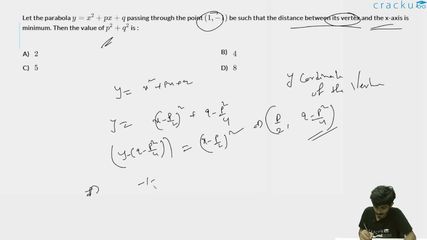
Let the parabola $$y = x^2 + px + q$$ passing through the point $$(1, -1)$$ be such that the distance between its vertex and the x-axis is minimum. Then the value of $$p^2 + q^2$$ is :
The general equation of the parabola is $$y = x^2 + px + q$$.
Because the parabola passes through $$(1,-1)$$, substitute $$x = 1,\, y = -1$$:
$$-1 = 1 + p + q \;\;\Longrightarrow\;\; q = -2 - p \;-(1)$$
The vertex of $$y = x^2 + px + q$$ lies at
$$x_v = -\frac{p}{2}, \qquad y_v = -\frac{p^2}{4} + q \;-(2)$$
Using $$(1)$$ in $$(2)$$, express the y-coordinate of the vertex only in terms of $$p$$:
$$y_v = -\frac{p^2}{4} + (-2 - p) = -\frac{p^2}{4} - p - 2 = -\frac{p^2 + 4p + 8}{4}$$
Distance of the vertex from the x-axis is the absolute value of $$y_v$$:
$$D(p) = \left| -\frac{p^2 + 4p + 8}{4} \right| = \frac{p^2 + 4p + 8}{4}$$
Minimising $$D(p)$$ is equivalent to minimising the quadratic numerator
$$f(p) = p^2 + 4p + 8$$
The minimum of a quadratic $$ap^2 + bp + c$$ occurs at $$p = -\frac{b}{2a}$$. Here, $$a = 1,\; b = 4$$, so
$$p_{\text{min}} = -\frac{4}{2} = -2$$
With $$p = -2$$, calculate $$q$$ from $$(1)$$:
$$q = -2 - (-2) = 0$$
Finally, evaluate $$p^2 + q^2$$:
$$p^2 + q^2 = (-2)^2 + 0^2 = 4$$
Therefore, the required value is $$4$$.
Option B which is: $$4$$
Click on the Email ☝️ to Watch the Video Solution
Create a FREE account and get:
_1.webp)

Educational materials for JEE preparation

Ask our AI anything

AI can make mistakes. Please verify important information.
AI can make mistakes. Please verify important information.


