
Join Our JEE Preparation Group
Prep with like-minded aspirants; Get access to free daily tests and study material.
Sign in
Please select an account to continue using cracku.in
↓ →
Join Our JEE Preparation Group
Prep with like-minded aspirants; Get access to free daily tests and study material.
If the domain of the function $$f(x) = \log_x(1 - \log_4(x^2 - 9x + 18))$$ is $$(\alpha, \beta) \cup (\gamma, \delta)$$, then $$\alpha + \beta + \gamma + \delta$$ is equal to
We need to find the domain of $$f(x) = \log_x(1 - \log_4(x^2 - 9x + 18))$$.
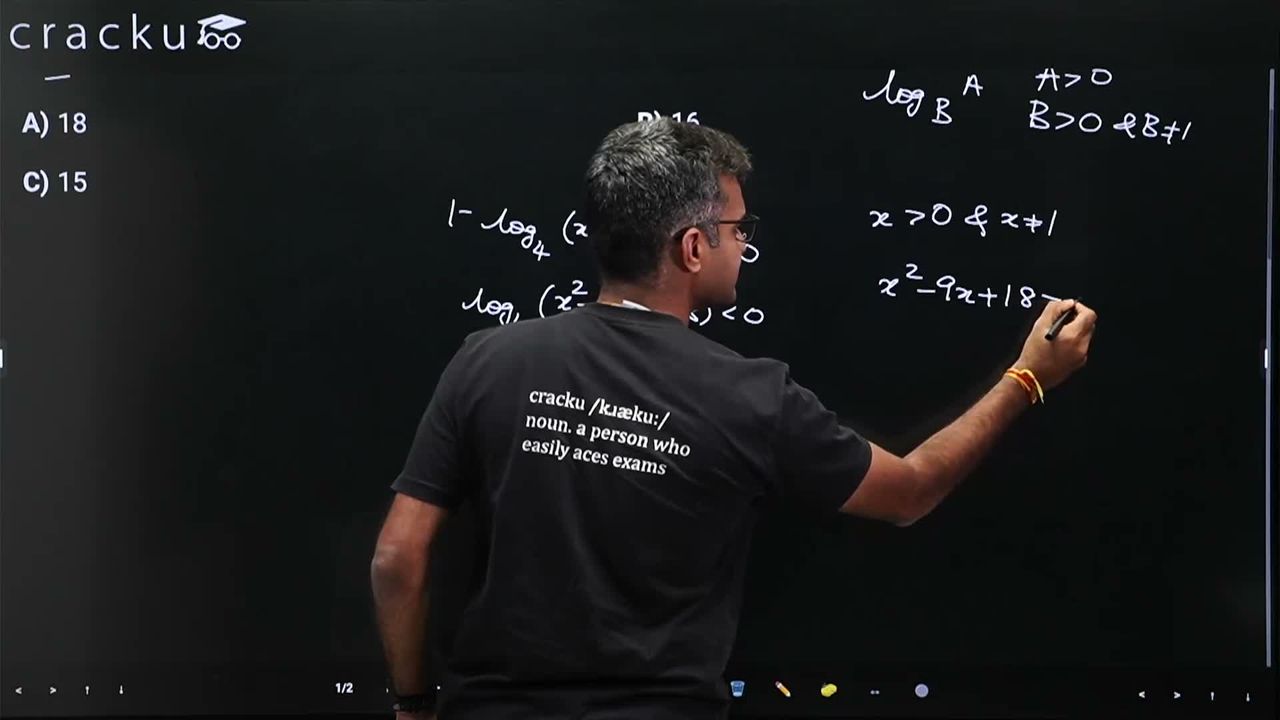
For $$\log_x(\cdot)$$ to be defined, we need $$x \gt 0$$, $$x \neq 1$$.
For $$\log_4(x^2 - 9x + 18)$$ to be defined, we need $$x^2 - 9x + 18 \gt 0$$, i.e., $$(x-3)(x-6) \gt 0$$, so $$x \lt 3$$ or $$x \gt 6$$.
The argument of the outer logarithm must be positive: $$1 - \log_4(x^2 - 9x + 18) \gt 0$$, which gives $$\log_4(x^2 - 9x + 18) \lt 1$$, so $$x^2 - 9x + 18 \lt 4$$, i.e., $$x^2 - 9x + 14 \lt 0$$, giving $$(x-2)(x-7) \lt 0$$, so $$2 \lt x \lt 7$$.
Combining all conditions: $$x \gt 0$$, $$x \neq 1$$, ($$ x \lt 3$$ or $$x \gt 6$$), and $$2 \lt x \lt 7$$:
From $$x \lt 3$$ and $$2 \lt x \lt 7$$: we get $$2 \lt x \lt 3$$. Since $$x \neq 1$$ is automatically satisfied, this gives $$(2, 3)$$.
From $$x \gt 6$$ and $$2 \lt x \lt 7$$: we get $$6 \lt x \lt 7$$, giving $$(6, 7)$$.
So $$(\alpha, \beta) = (2, 3)$$ and $$(\gamma, \delta) = (6, 7)$$.
Therefore, $$\alpha + \beta + \gamma + \delta = 2 + 3 + 6 + 7 = 18$$.
Hence, the correct answer is Option A.
Was this solution helpful?
Click on the Email ☝️ to Watch the Video Solution
Create a FREE account and get:
_1.webp)

Educational materials for JEE preparation

Ask our AI anything

AI can make mistakes. Please verify important information.
AI can make mistakes. Please verify important information.
