
Join Our JEE Preparation Group
Prep with like-minded aspirants; Get access to free daily tests and study material.
Sign in
Please select an account to continue using cracku.in
↓ →
Join Our JEE Preparation Group
Prep with like-minded aspirants; Get access to free daily tests and study material.
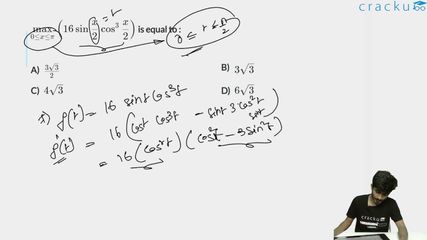
$$\displaystyle\max_{0 \leq x \leq \pi}\left(16\sin\frac{x}{2}\cos^3\frac{x}{2}\right)$$ is equal to :
Let $$t=\frac{x}{2}$$. When $$0\le x\le \pi$$, we get $$0\le t\le \frac{\pi}{2}$$.
The expression becomes $$16\sin\frac{x}{2}\cos^{3}\frac{x}{2}=16\sin t\,\cos^{3}t$$ Denote this by $$F(t)=16\sin t\,\cos^{3}t\,.$$
STEP 1 - Rewrite in a handier form. Write one $$\cos t$$ together with $$\sin t$$ to form $$\sin 2t$$:
$$F(t)=16\bigl(\sin t\cos t\bigr)\cos^{2}t =16\left(\frac{\sin 2t}{2}\right)\cos^{2}t =8\sin 2t\cos^{2}t$$
Next express $$\cos^{2}t$$ with double-angle: $$\cos^{2}t=\frac{1+\cos 2t}{2}$$. Hence
$$F(t)=8\sin 2t\left(\frac{1+\cos 2t}{2}\right)=4\sin 2t\,(1+\cos 2t)\,.$$
STEP 2 - Put $$u=2t$$. Then $$u$$ ranges from $$0$$ to $$\pi$$ and
$$F(u)=4\sin u\,(1+\cos u)\,,\qquad 0\le u\le \pi.$$
Define $$g(u)=\sin u\,(1+\cos u)$$ so that $$F(u)=4\,g(u)$$. To locate maxima we differentiate $$g(u)$$.
STEP 3 - Differentiate and find critical points.
$$g'(u)=\cos u\,(1+\cos u)+\sin u\,(-\sin u) =\cos u+\cos^{2}u-\sin^{2}u$$ Using $$\sin^{2}u=1-\cos^{2}u$$, we get
$$g'(u)=\cos u+\cos^{2}u-(1-\cos^{2}u)=2\cos^{2}u+\cos u-1.$$
Set $$g'(u)=0$$:
$$2\cos^{2}u+\cos u-1=0.$$
Let $$y=\cos u$$. Solve the quadratic
$$2y^{2}+y-1=0 \;\;\Longrightarrow\;\;y=\frac{-1\pm\sqrt{1+8}}{4}=\frac{-1\pm3}{4}.$$
Hence $$y=\frac12$$ or $$y=-1$$. Within $$0\le u\le\pi$$ we have $$\cos u=\frac12\;\Rightarrow\;u=\frac{\pi}{3},$$ $$\cos u=-1\;\Rightarrow\;u=\pi.$$
STEP 4 - Evaluate $$F(u)$$ at all candidates.
• At $$u=0$$: $$g(0)=\sin0(1+\cos0)=0\;\;\Rightarrow\;F(0)=0.$$br/> • At $$u=\pi$$: $$g(\pi)=\sin\pi(1+\cos\pi)=0\;\;\Rightarrow\;F(\pi)=0.$$br/> • At $$u=\dfrac{\pi}{3}$$: $$\sin\frac{\pi}{3}=\frac{\sqrt3}{2},\qquad\cos\frac{\pi}{3}=\frac12.$$ $$g\!\left(\frac{\pi}{3}\right)=\frac{\sqrt3}{2}\left(1+\frac12\right)=\frac{\sqrt3}{2}\cdot\frac32=\frac{3\sqrt3}{4}.$$ Therefore $$F_{\max}=4\,g\!\left(\frac{\pi}{3}\right)=4\cdot\frac{3\sqrt3}{4}=3\sqrt3.$$
Since all other points give a smaller value, the maximum of the original expression is $$3\sqrt3$$.
Hence the required maximum is $$3\sqrt3$$.
Option B which is: $$3\sqrt3$$
Was this solution helpful?
Click on the Email ☝️ to Watch the Video Solution
Create a FREE account and get:
_1.webp)

Educational materials for JEE preparation

Ask our AI anything

AI can make mistakes. Please verify important information.
AI can make mistakes. Please verify important information.
