
Join Our JEE Preparation Group
Prep with like-minded aspirants; Get access to free daily tests and study material.
Sign in
Please select an account to continue using cracku.in
↓ →
Join Our JEE Preparation Group
Prep with like-minded aspirants; Get access to free daily tests and study material.
An electric toaster has resistance of $$60 \text{ } \Omega$$ at room temperature $$(27°C)$$. The toaster is connected to a $$220 \text{ V}$$ supply. If the current flowing through it reaches $$2.75 \text{ A}$$, the temperature attained by toaster is around: (if $$\alpha = 2 \times 10^{-4} \text{ °C}^{-1}$$)
The resistance of a conductor varies with temperature according to:
$$R = R_0(1 + \alpha \Delta T)$$
where $$R_0$$ is the resistance at the reference temperature, $$\alpha$$ is the temperature coefficient of resistance, and $$\Delta T$$ is the change in temperature.
Given: $$R_0 = 60 \text{ } \Omega$$ at $$27°C$$, supply voltage $$= 220 \text{ V}$$, current $$= 2.75 \text{ A}$$, $$\alpha = 2 \times 10^{-4} \text{ °C}^{-1}$$.
First, find the resistance at the operating temperature:
$$R = \frac{V}{I} = \frac{220}{2.75} = 80 \text{ } \Omega$$
Now apply the temperature-resistance relation:
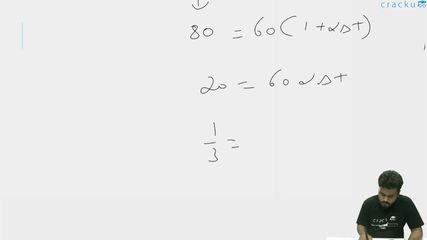
$$80 = 60(1 + 2 \times 10^{-4} \times \Delta T)$$
$$\frac{80}{60} = 1 + 2 \times 10^{-4} \times \Delta T$$
$$\frac{4}{3} = 1 + 2 \times 10^{-4} \times \Delta T$$
$$\frac{1}{3} = 2 \times 10^{-4} \times \Delta T$$
$$\Delta T = \frac{1}{3 \times 2 \times 10^{-4}} = \frac{10^4}{6} \approx 1667°C$$
The final temperature is:
$$T = 27 + 1667 = 1694°C$$
The correct answer is $$1694°C$$.
Was this solution helpful?
Click on the Email ☝️ to Watch the Video Solution
Create a FREE account and get:
_1.webp)

Educational materials for JEE preparation

Ask our AI anything

AI can make mistakes. Please verify important information.
AI can make mistakes. Please verify important information.
