
Join Our JEE Preparation Group
Prep with like-minded aspirants; Get access to free daily tests and study material.
Sign in
Please select an account to continue using cracku.in
↓ →
Join Our JEE Preparation Group
Prep with like-minded aspirants; Get access to free daily tests and study material.
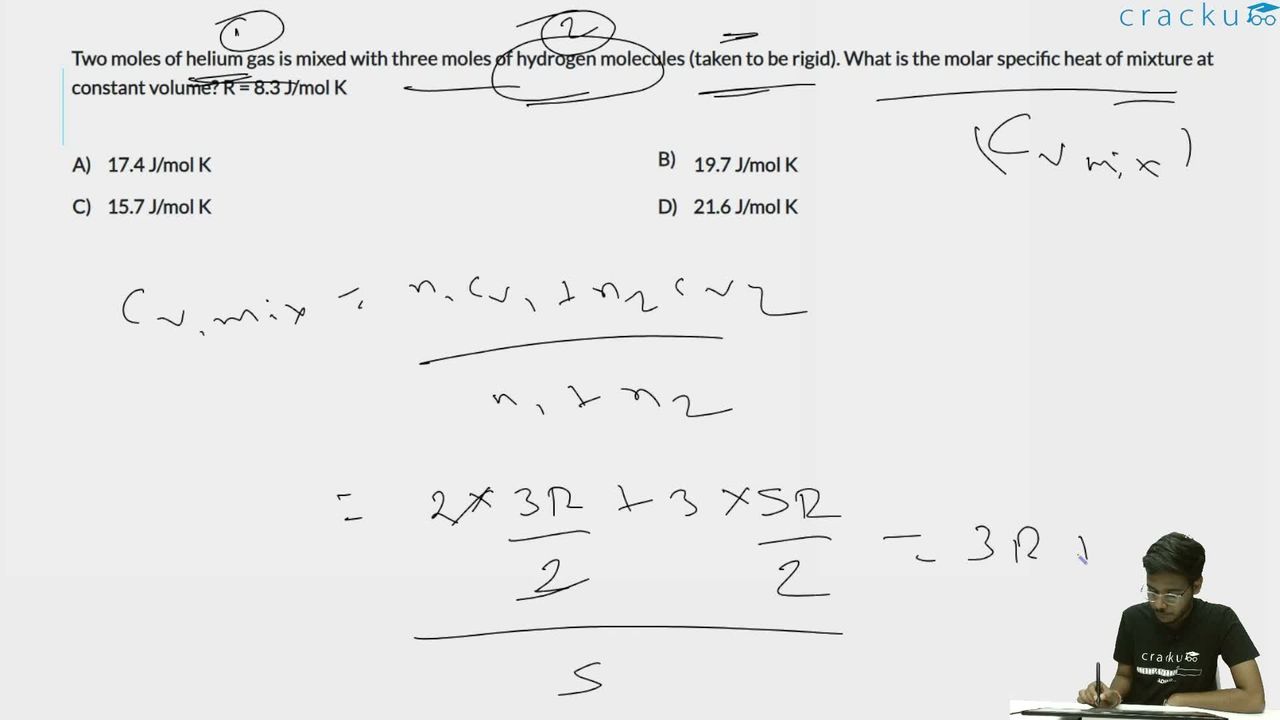
Two moles of helium gas is mixed with three moles of hydrogen molecules (taken to be rigid). What is the molar specific heat of mixture at constant volume? R = 8.3 J/mol K
We first recall the general result for an ideal gas: if a molecule has $$f$$ degrees of freedom, then its molar specific heat at constant volume is given by the formula $$C_v = \dfrac{f}{2}\,R,$$ because the internal energy of one mole is $$U = \dfrac{f}{2}\,RT$$ and differentiating with respect to temperature at constant volume gives $$\left(\dfrac{\partial U}{\partial T}\right)_V = \dfrac{f}{2}\,R.$$
For a monatomic gas such as helium, there are only the three translational degrees of freedom, so $$f = 3.$$ Therefore, for each mole of helium, we have
$$C_{v,\text{He}} = \dfrac{3}{2}\,R.$$
A hydrogen molecule ($$\text{H}_2$$) is di-atomic and is stated to be rigid in the question, which means it possesses three translational and two rotational degrees of freedom, giving $$f = 5.$$ Hence, for each mole of hydrogen,
$$C_{v,\text{H}_2} = \dfrac{5}{2}\,R.$$
Now we form the mixture. The numbers of moles are:
Helium: $$n_{\text{He}} = 2,$$ Hydrogen: $$n_{\text{H}_2} = 3.$$
The total heat capacity of the mixture at constant volume is the sum of the individual contributions:
$$C_V^{\text{(total)}} \;=\; n_{\text{He}}\,C_{v,\text{He}} \;+\; n_{\text{H}_2}\,C_{v,\text{H}_2}.$$
Substituting the values just obtained, we get
$$\begin{aligned} C_V^{\text{(total)}} & = 2\left(\dfrac{3}{2}\,R\right) + 3\left(\dfrac{5}{2}\,R\right) \\ & = 2 \times \dfrac{3}{2}\,R + 3 \times \dfrac{5}{2}\,R \\ & = 3R + \dfrac{15}{2}\,R \\ & = 3R + 7.5R \\ & = 10.5R. \end{aligned}$$
The mixture contains a total of
$$n_{\text{total}} = n_{\text{He}} + n_{\text{H}_2} = 2 + 3 = 5 \text{ moles}.$$
The required quantity is the molar specific heat of the mixture, defined as
$$C_v^{\text{(mix)}} = \dfrac{C_V^{\text{(total)}}}{n_{\text{total}}}.$$
Substituting the numbers:
$$\begin{aligned} C_v^{\text{(mix)}} & = \dfrac{10.5R}{5} \\ & = 2.1R. \end{aligned}$$
We are given $$R = 8.3 \text{ J mol}^{-1}\text{K}^{-1},$$ so
$$\begin{aligned} C_v^{\text{(mix)}} & = 2.1 \times 8.3 \\ & = 17.43 \text{ J mol}^{-1}\text{K}^{-1}. \end{aligned}$$
This numerical value matches closest with the option $$17.4 \text{ J/mol K}.$$
Hence, the correct answer is Option A.
Click on the Email ☝️ to Watch the Video Solution
Create a FREE account and get:
_1.webp)

Educational materials for JEE preparation

Ask our AI anything

AI can make mistakes. Please verify important information.
AI can make mistakes. Please verify important information.


