
Join Our JEE Preparation Group
Prep with like-minded aspirants; Get access to free daily tests and study material.
Sign in
Please select an account to continue using cracku.in
↓ →
Join Our JEE Preparation Group
Prep with like-minded aspirants; Get access to free daily tests and study material.
Two identical charged particles each having a mass $$10$$ g and charge $$2.0 \times 10^{-7}$$ C are placed on a horizontal table with a separation of $$L$$ between them such that they stay in limited equilibrium. If the coefficient of friction between each particle and the table is $$0.25$$, find the value of $$L$$. [Use $$g = 10$$ ms$$^{-2}$$]
The mass of each particle is $$m = 10$$ g $$= 0.01$$ kg, the charge is $$q = 2.0 \times 10^{-7}$$ C, the coefficient of friction is $$\mu = 0.25$$, and $$g = 10$$ m/s$$^2$$.
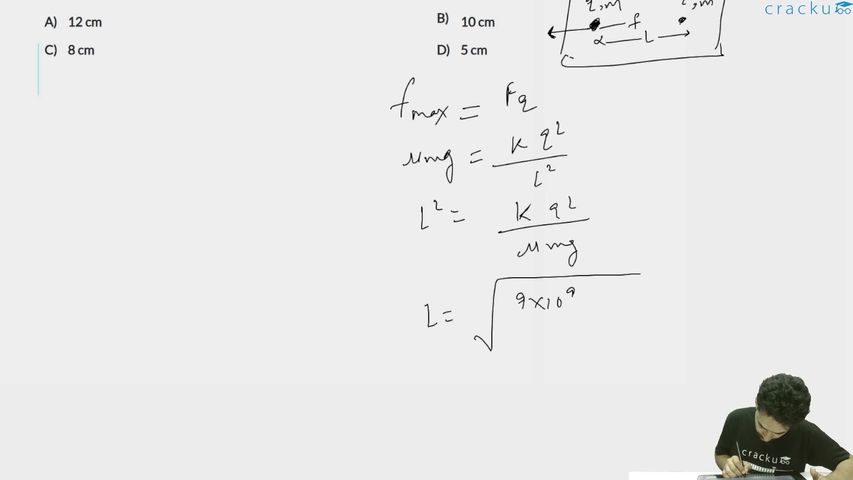
The two identical charged particles repel each other with the Coulomb force, and they remain in equilibrium because friction balances this repulsive force. At limiting equilibrium the Coulomb repulsive force equals the maximum static friction force:
$$F_{\text{Coulomb}} = F_{\text{friction}}$$ $$\frac{kq^2}{L^2} = \mu mg$$
Solving for $$L^2$$ gives $$L^2 = \frac{kq^2}{\mu mg}$$. Substituting numerical values: $$L^2 = \frac{9 \times 10^9 \times (2.0 \times 10^{-7})^2}{0.25 \times 0.01 \times 10}$$. Calculating the numerator: $$(2.0 \times 10^{-7})^2 = 4.0 \times 10^{-14}$$ and $$9 \times 10^9 \times 4.0 \times 10^{-14} = 36 \times 10^{-5} = 3.6 \times 10^{-4}$$. The denominator is $$0.25 \times 0.01 \times 10 = 0.025$$. Therefore, $$L^2 = \frac{3.6 \times 10^{-4}}{0.025} = \frac{3.6 \times 10^{-4}}{2.5 \times 10^{-2}} = 1.44 \times 10^{-2} \text{ m}^2$$.
Thus, $$L = \sqrt{1.44 \times 10^{-2}} = 0.12 \text{ m} = 12 \text{ cm}$$, so the separation $$L = 12$$ cm.
The correct answer is Option A.
Was this solution helpful?
Click on the Email ☝️ to Watch the Video Solution
Create a FREE account and get:
_1.webp)

Educational materials for JEE preparation

Ask our AI anything

AI can make mistakes. Please verify important information.
AI can make mistakes. Please verify important information.
