
Join Our JEE Preparation Group
Prep with like-minded aspirants; Get access to free daily tests and study material.
Sign in
Please select an account to continue using cracku.in
↓ →
Join Our JEE Preparation Group
Prep with like-minded aspirants; Get access to free daily tests and study material.
Model a torch battery of length $$l$$ to be made up of a thin cylindrical bar of radius $$a$$ and a concentric thin cylindrical shell of radius $$b$$ filled in between with an electrolyte of resistivity $$\rho$$ (see figure). If the battery is connected to a resistance of value $$R$$, the maximum Joule heating in $$R$$ will take place for:
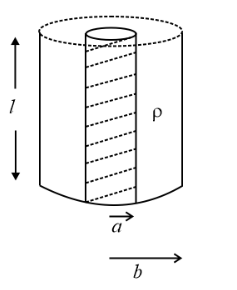
We model the torch battery as an ideal emf source $$\mathcal E$$ in series with its internal resistance, which is the resistance of the electrolyte that fills the space between the inner solid rod (radius $$a$$) and the outer cylindrical shell (inner radius $$b$$). Our first task is therefore to calculate this internal resistance, which we shall denote by $$r$$.
To find $$r$$, we remember the differential formula for the resistance of a conductor:
$$dR=\rho\,\dfrac{dl}{A},$$
where $$\rho$$ is the resistivity, $$dl$$ is the infinitesimal length of the current path, and $$A$$ is the cross-sectional area perpendicular to the current.
In the present arrangement the current flows radially outward from the inner rod to the outer shell. Choose an imaginary cylindrical surface of radius $$r$$ (with $$a<r<b$$) and thickness $$dr$$. The current crosses this surface normally, so:
• The path length for the current element is the radial thickness $$dl=dr$$.
• The area normal to the current is the curved area of the cylinder, $$A = 2\pi r\,l$$, where $$l$$ is the length of the battery.
Substituting these into the differential resistance formula, we obtain
$$dR=\rho\,\dfrac{dr}{2\pi r\,l}.$$
To get the total internal resistance, integrate from the inner radius $$a$$ to the outer radius $$b$$:
$$r = \int_{a}^{b}dR = \int_{a}^{b}\rho\,\dfrac{dr}{2\pi r\,l} = \dfrac{\rho}{2\pi l}\int_{a}^{b}\dfrac{dr}{r} = \dfrac{\rho}{2\pi l}\,\Bigl[\ln r\Bigr]_{a}^{b} = \dfrac{\rho}{2\pi l}\,\ln\!\left(\dfrac{b}{a}\right).$$
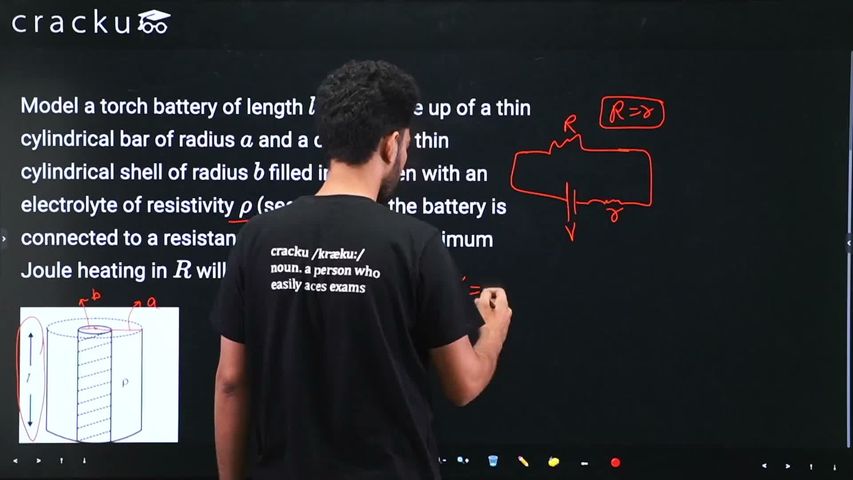
Now the circuit consists of the emf $$\mathcal E$$, the internal resistance $$r$$ and the external resistance $$R$$ in series. The Joule heating (power) in the external resistor is
$$P=\dfrac{\mathcal E^{2}R}{\left(R+r\right)^{2}}.$$
The maximum power transfer theorem states that, for a fixed internal resistance $$r$$, the power delivered to $$R$$ is maximum when
$$R=r.$$
Therefore, using the explicit form of $$r$$ we just calculated, the condition for maximum Joule heating is
$$R=\dfrac{\rho}{2\pi l}\,\ln\!\left(\dfrac{b}{a}\right).$$
This expression matches Option B.
Hence, the correct answer is Option B.
Was this solution helpful?
Click on the Email ☝️ to Watch the Video Solution
Create a FREE account and get:
_1.webp)

Educational materials for JEE preparation

Ask our AI anything

AI can make mistakes. Please verify important information.
AI can make mistakes. Please verify important information.
