
Join Our JEE Preparation Group
Prep with like-minded aspirants; Get access to free daily tests and study material.
Sign in
Please select an account to continue using cracku.in
↓ →
Join Our JEE Preparation Group
Prep with like-minded aspirants; Get access to free daily tests and study material.
A group of 9 students, $$s_1, s_2, \ldots, s_9$$, is to be divided to form three teams $$X$$, $$Y$$ and $$Z$$ of sizes 2, 3, and 4, respectively. Suppose that $$s_1$$ cannot be selected for the team $$X$$, and $$s_2$$ cannot be selected for the team $$Y$$. Then the number of ways to form such teams is ________.
Correct Answer: 665
First, treat the three teams $$X$$ (size $$2$$), $$Y$$ (size $$3$$) and $$Z$$ (size $$4$$) as labelled; changing a student from one team to another gives a different arrangement.
Total arrangements without any restriction
Choose the two members of $$X$$, then the three members of $$Y$$; the remaining four automatically form $$Z$$:
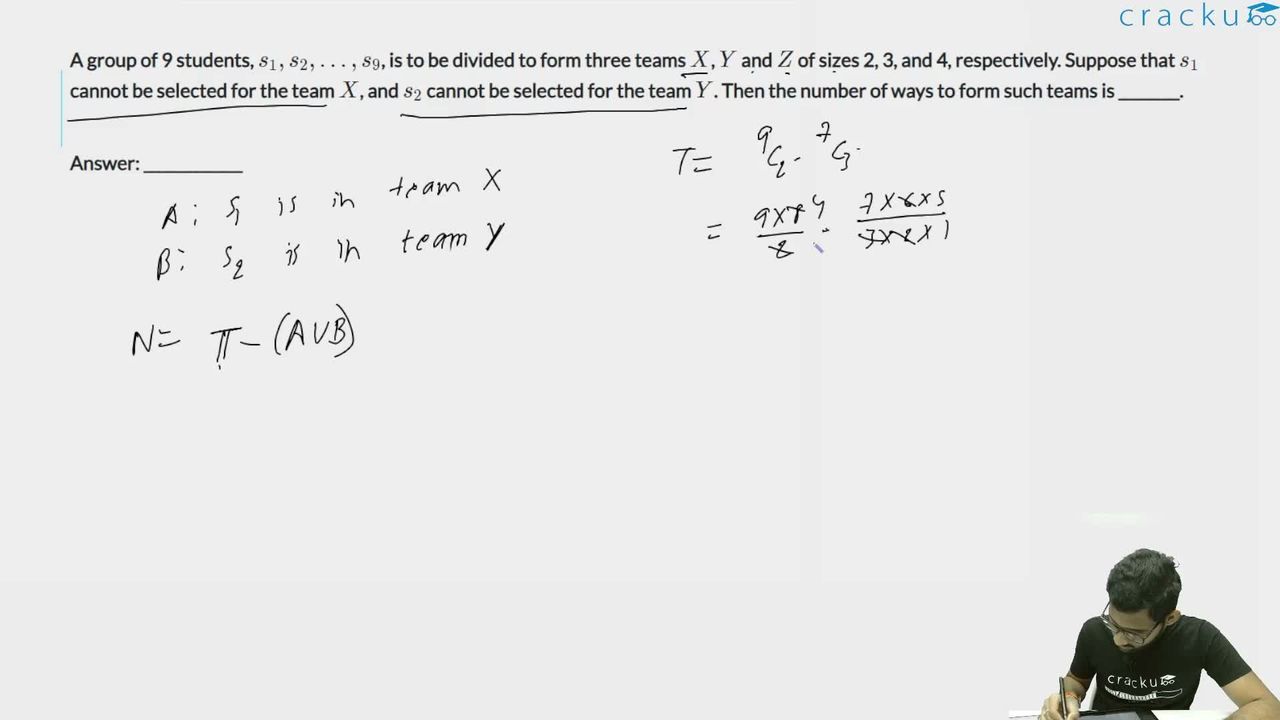
$$T = \binom{9}{2}\,\binom{7}{3} = 36 \times 35 = 1260.$$
Introduce two “bad” events:
$$A$$ : student $$s_1$$ is placed in team $$X$$ (not allowed).
$$B$$ : student $$s_2$$ is placed in team $$Y$$ (not allowed).
We need the count of arrangements that avoid both $$A$$ and $$B$$. Use the inclusion-exclusion principle:
Number of valid arrangements $$= T - |A| - |B| + |A\cap B|.$$
Count |A| (arrangements with $$s_1$$ in $$X$$)
Fix $$s_1$$ in $$X$$, pick one more member for $$X$$ from the remaining $$8$$ students, then form $$Y$$ from the remaining $$7$$ students:
$$|A| = \binom{8}{1}\,\binom{7}{3} = 8 \times 35 = 280.$$
Count |B| (arrangements with $$s_2$$ in $$Y$$)
Fix $$s_2$$ in $$Y$$, pick two more members for $$Y$$ from the remaining $$8$$ students, then form $$X$$ from the remaining $$6$$ students:
$$|B| = \binom{8}{2}\,\binom{6}{2} = 28 \times 15 = 420.$$
Count |A ∩ B| (both $$s_1$$ in $$X$$ and $$s_2$$ in $$Y$$)
Place $$s_1$$ in $$X$$ and choose one more member for $$X$$ from the $$7$$ students other than $$s_2$$: $$\binom{7}{1}=7$$.
Now $$s_2$$ is in $$Y$$; pick the remaining two members of $$Y$$ from the $$6$$ students still free: $$\binom{6}{2}=15$$.
$$|A\cap B| = 7 \times 15 = 105.$$
Apply inclusion-exclusion
$$\text{Valid arrangements}=1260 - 280 - 420 + 105 = 665.$$
Hence, the required number of ways to form the teams is 665.
Was this solution helpful?
Click on the Email ☝️ to Watch the Video Solution
Create a FREE account and get:
_1.webp)

Educational materials for JEE preparation

Ask our AI anything

AI can make mistakes. Please verify important information.
AI can make mistakes. Please verify important information.
