
Join Our JEE Preparation Group
Prep with like-minded aspirants; Get access to free daily tests and study material.
Sign in
Please select an account to continue using cracku.in
↓ →
Join Our JEE Preparation Group
Prep with like-minded aspirants; Get access to free daily tests and study material.
A capacitor has air as dielectric medium and two conducting plates of area $$12 \text{ cm}^2$$ and they are $$0.6$$ cm apart. When a slab of dielectric having area $$12 \text{ cm}^2$$ and $$0.6$$ cm thickness is inserted between the plates, one of the conducting plates has to be moved by $$0.2$$ cm to keep the capacitance same as in previous case. The dielectric constant of the slab is : (Given $$\epsilon_0 = 8.834 \times 10^{-12}$$ F/m)
Find the dielectric constant of a slab inserted in a parallel plate capacitor.
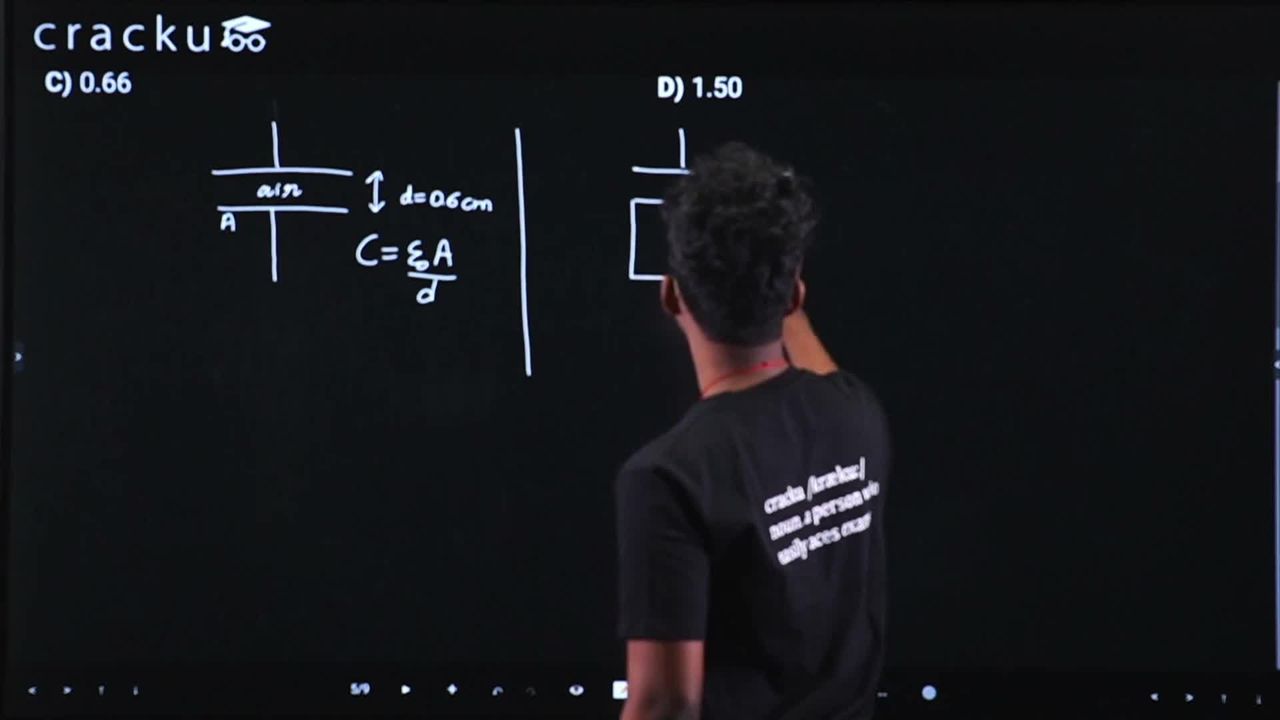
Plate area $$A = 12$$ cm$$^2$$, separation $$d = 0.6$$ cm, and the original capacitance (air) is $$C_0 = \frac{\varepsilon_0 A}{d}$$.
When a dielectric slab of thickness $$t = 0.6$$ cm fills the gap and one plate is moved by 0.2 cm to maintain the same capacitance, the new separation becomes 0.6 + 0.2 = 0.8 cm. The dielectric slab still has thickness 0.6 cm, and the remaining 0.2 cm is air.
The capacitance with the dielectric and air gap is $$C = \frac{\varepsilon_0 A}{\frac{t}{\kappa} + d_{\text{air}}} = \frac{\varepsilon_0 A}{\frac{0.6}{\kappa} + 0.2}$$.
Setting $$C = C_0$$ gives $$\frac{\varepsilon_0 A}{\frac{0.6}{\kappa} + 0.2} = \frac{\varepsilon_0 A}{0.6}$$, so $$\frac{0.6}{\kappa} + 0.2 = 0.6 \implies \frac{0.6}{\kappa} = 0.4 \implies \kappa = \frac{0.6}{0.4} = 1.5$$.
The correct answer is Option (4): 1.50.
Was this solution helpful?
Click on the Email ☝️ to Watch the Video Solution
Create a FREE account and get:
_1.webp)

Educational materials for JEE preparation

Ask our AI anything

AI can make mistakes. Please verify important information.
AI can make mistakes. Please verify important information.
