NTA JEE Mains 9th April 2024 Shift 2
For the following questions answer them individually
NTA JEE Mains 9th April 2024 Shift 2 - Question 21
The resultant of two vectors $$\vec{A}$$ and $$\vec{B}$$ is perpendicular to $$\vec{A}$$ and its magnitude is half that of $$\vec{B}$$. The angle between vectors $$\vec{A}$$ and $$\vec{B}$$ is ______ °.
789
456
123
0.-
Clear All
NTA JEE Mains 9th April 2024 Shift 2 - Question 22
A force $$(3x^2 + 2x - 5) \text{ N}$$ displaces a body from $$x = 2 \text{ m}$$ to $$x = 4 \text{ m}$$. Work done by this force is ______ J.
789
456
123
0.-
Clear All
NTA JEE Mains 9th April 2024 Shift 2 - Question 23
A circular disc reaches from top to bottom of an inclined plane of length $$l$$. When it slips down the plane, it takes $$t$$ s. When it rolls down the plane then it takes $$\left(\frac{\alpha}{2}\right)^{1/2} t$$ s, where $$\alpha$$ is ______
789
456
123
0.-
Clear All

NTA JEE Mains 9th April 2024 Shift 2 - Question 24
At room temperature $$(27°C)$$, the resistance of a heating element is $$50\Omega$$. The temperature coefficient of the material is $$2.4 \times 10^{-4} \text{ °C}^{-1}$$. The temperature of the element, when its resistance is $$62\Omega$$, is ______ °C.
789
456
123
0.-
Clear All
NTA JEE Mains 9th April 2024 Shift 2 - Question 25
A particle of mass $$0.50 \text{ kg}$$ executes simple harmonic motion under force $$F = -50 \text{ (Nm}^{-1}\text{)}x$$. The time period of oscillation is $$\frac{\pi}{x}$$ s. The value of $$x$$ is ______ (Given $$\pi = \frac{22}{7}$$)
789
456
123
0.-
Clear All
NTA JEE Mains 9th April 2024 Shift 2 - Question 26
An electric field $$\vec{E} = (2x\hat{i}) \text{ NC}^{-1}$$ exists in space. A cube of side $$2 \text{ m}$$ is placed in the space as per figure given below.
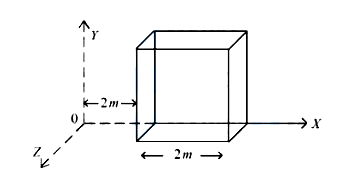
The electric flux through the cube is ______ $$\text{Nm}^2/\text{C}$$.
789
456
123
0.-
Clear All
NTA JEE Mains 9th April 2024 Shift 2 - Question 27
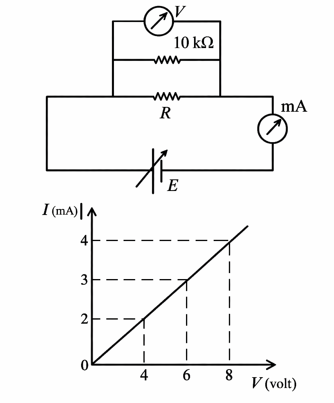
To determine the resistance $$(R)$$ of a wire, a circuit is designed below. The $$V - I$$ characteristic curve for this circuit is plotted for the voltmeter and the ammeter readings as shown in figure. The value of $$R$$ is ______ $$\Omega$$.
789
456
123
0.-
Clear All
NTA JEE Mains 9th April 2024 Shift 2 - Question 28
A straight magnetic strip has a magnetic moment of $$44 \text{ Am}^2$$. If the strip is bent in a semicircular shape, its magnetic moment will be ______ $$\text{Am}^2$$. (given $$\pi = \frac{22}{7}$$)
789
456
123
0.-
Clear All
NTA JEE Mains 9th April 2024 Shift 2 - Question 29
A capacitor of reactance $$4\sqrt{3} \Omega$$ and a resistor of resistance $$4\Omega$$ are connected in series with an ac source of peak value $$8\sqrt{2} \text{ V}$$. The power dissipation in the circuit is ______ W.
789
456
123
0.-
Clear All
NTA JEE Mains 9th April 2024 Shift 2 - Question 30
Monochromatic light of wavelength $$500 \text{ nm}$$ is used in Young's double slit experiment. An interference pattern is obtained on a screen. When one of the slits is covered with a very thin glass plate (refractive index $$= 1.5$$), the central maximum is shifted to a position previously occupied by the $$4^{th}$$ bright fringe. The thickness of the glass-plate is ______ $$\mu m$$.
789
456
123
0.-
Clear All