For the following questions answer them individually
The sum of all possible values of $$\theta \in [-\pi, 2\pi]$$, for which $$\frac{1 + i\cos\theta}{1 - 2i\cos\theta}$$ is purely imaginary, is equal to :
The number of ways five alphabets can be chosen from the alphabets of the word MATHEMATICS, where the chosen alphabets are not necessarily distinct, is equal to :
In an increasing geometric progression of positive terms, the sum of the second and sixth terms is $$\frac{70}{3}$$ and the product of the third and fifth terms is 49. Then the sum of the $$4^{th}$$, $$6^{th}$$ and $$8^{th}$$ terms is equal to :
If the term independent of $$x$$ in the expansion of $$\left(\sqrt{a}x^2 + \frac{1}{2x^3}\right)^{10}$$ is 105, then $$a^2$$ is equal to :
If the value of $$\frac{3\cos 36° + 5\sin 18°}{5\cos 36° - 3\sin 18°}$$ is $$\frac{a\sqrt{5} - b}{c}$$, where $$a, b, c$$ are natural numbers and $$\gcd(a, c) = 1$$, then $$a + b + c$$ is equal to :
If the image of the point $$(-4, 5)$$ in the line $$x + 2y = 2$$ lies on the circle $$(x + 4)^2 + (y - 3)^2 = r^2$$, then $$r$$ is equal to :
If the line segment joining the points $$(5, 2)$$ and $$(2, a)$$ subtends an angle $$\frac{\pi}{4}$$ at the origin, then the absolute value of the product of all possible values of $$a$$ is :
Let $$A = \{2, 3, 6, 8, 9, 11\}$$ and $$B = \{1, 4, 5, 10, 15\}$$. Let $$R$$ be a relation on $$A \times B$$ defined by $$(a, b)R(c, d)$$ if and only if $$3ad - 7bc$$ is an even integer. Then the relation $$R$$ is :
If $$\alpha \neq a, \beta \neq b, \gamma \neq c$$ and $$\begin{vmatrix} \alpha & b & c \\ a & \beta & c \\ a & b & \gamma \end{vmatrix} = 0$$, then $$\frac{a}{\alpha - a} + \frac{b}{\beta - b} + \frac{\gamma}{\gamma - c}$$ is equal to :
If the system of equations $$x + 4y - z = \lambda$$, $$7x + 9y + \mu z = -3$$, $$5x + y + 2z = -1$$ has infinitely many solutions, then $$(2\mu + 3\lambda)$$ is equal to :
Let $$f(x) = \begin{cases} -a & \text{if } -a \leq x \leq 0 \\ x + a & \text{if } 0 < x \leq a \end{cases}$$ where $$a > 0$$ and $$g(x) = (f(x|) - |f(x)|)/2$$. Then the function $$g : [-a, a] \rightarrow [-a, a]$$ is :
For $$a, b > 0$$, let $$f(x) = \begin{cases} \frac{\tan((a+1)x) + b\tan x}{x}, & x < 0 \\ 3, & x = 0 \\ \frac{\sqrt{ax + b^2x^2} - \sqrt{ax}}{b\sqrt{ax}\sqrt{x}}, & x > 0 \end{cases}$$ be a continuous function at $$x = 0$$. Then $$\frac{b}{a}$$ is equal to :
If the function $$f(x) = 2x^3 - 9ax^2 + 12a^2x + 1$$, $$a > 0$$ has a local maximum at $$x = \alpha$$ and a local minimum at $$x = \alpha^2$$, then $$\alpha$$ and $$\alpha^2$$ are the roots of the equation :
Let $$\int_{\alpha}^{\log_e 4} \frac{dx}{\sqrt{e^x - 1}} = \frac{\pi}{6}$$. Then $$e^{\alpha}$$ and $$e^{-\alpha}$$ are the roots of the equation :
The area of the region in the first quadrant inside the circle $$x^2 + y^2 = 8$$ and outside the parabola $$y^2 = 2x$$ is equal to :
Let $$y = y(x)$$ be the solution curve of the differential equation $$\sec y \frac{dy}{dx} + 2x\sin y = x^3\cos y$$, $$y(1) = 0$$. Then $$y(\sqrt{3})$$ is equal to :
Let $$\vec{a} = 4\hat{i} - \hat{j} + \hat{k}$$, $$\vec{b} = 11\hat{i} - \hat{j} + \hat{k}$$ and $$\vec{c}$$ be a vector such that $$(\vec{a} + \vec{b}) \times \vec{c} = \vec{c} \times (-2\vec{a} + 3\vec{b})$$. If $$(2\vec{a} + 3\vec{b}) \cdot \vec{c} = 1670$$, then $$|\vec{c}|^2$$ is equal to :
Let $$\vec{a} = \hat{i} + 2\hat{j} + 3\hat{k}$$, $$\vec{b} = 2\hat{i} + 3\hat{j} - 5\hat{k}$$ and $$\vec{c} = 3\hat{i} - \hat{j} + \lambda\hat{k}$$ be three vectors. Let $$\vec{r}$$ be a unit vector along $$\vec{b} + \vec{c}$$. If $$\vec{r} \cdot \vec{a} = 3$$, then $$3\lambda$$ is equal to :
If the shortest distance between the lines $$\frac{x - \lambda}{2} = \frac{y - 4}{3} = \frac{z - 3}{4}$$ and $$\frac{x - 2}{4} = \frac{y - 4}{6} = \frac{z - 7}{8}$$ is $$\frac{13}{\sqrt{29}}$$, then a value of $$\lambda$$ is :
There are three bags $$X, Y$$ and $$Z$$. Bag $$X$$ contains 5 one-rupee coins and 4 five-rupee coins; Bag $$Y$$ contains 4 one-rupee coins and 5 five-rupee coins and Bag $$Z$$ contains 3 one-rupee coins and 6 five-rupee coins. A bag is selected at random and a coin drawn from it at random is found to be a one-rupee coin. Then the probability, that it came from bag Y, is :
The number of distinct real roots of the equation $$|x + 1||x + 3| - 4|x + 2| + 5 = 0$$, is _____
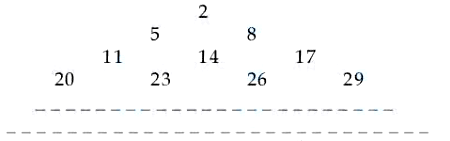
An arithmetic progression is written in the following way:
The sum of all the terms of the $$10^{th}$$ row is _____
Let a ray of light passing through the point $$(3, 10)$$ reflects on the line $$2x + y = 6$$ and the reflected ray passes through the point $$(7, 2)$$. If the equation of the incident ray is $$ax + by + 1 = 0$$, then $$a^2 + b^2 + 3ab$$ is equal to _____
Let S be the focus of the hyperbola $$\frac{x^2}{3} - \frac{y^2}{5} = 1$$, on the positive x-axis. Let C be the circle with its centre at $$A(\sqrt{6}, \sqrt{5})$$ and passing through the point S. If O is the origin and SAB is a diameter of C, then the square of the area of the triangle OSB is equal to _____
If $$\alpha = \lim_{x \to 0^+} \left(\frac{e^{\sqrt{\tan x}} - e^{\sqrt{x}}}{\sqrt{\tan x} - \sqrt{x}}\right)$$ and $$\beta = \lim_{x \to 0} (1 + \sin x)^{\frac{1}{2}\cot x}$$ are the roots of the quadratic equation $$ax^2 + bx - \sqrt{e} = 0$$, then $$12\log_e(a + b)$$ is equal to _____
Let $$a, b, c \in \mathbb{N}$$ and $$a < b < c$$. Let the mean, the mean deviation about the mean and the variance of the 5 observations $$9, 25, a, b, c$$ be $$18, 4$$ and $$\frac{136}{5}$$, respectively. Then $$2a + b - c$$ is equal to _____
Let A be the region enclosed by the parabola $$y^2 = 2x$$ and the line $$x = 24$$. Then the maximum area of the rectangle inscribed in the region A is _____
If $$\int \frac{1}{\sqrt[5]{(x-1)^4(x+3)^6}} dx = A\left(\frac{\alpha x - 1}{\beta x + 3}\right)^B + C$$, where C is the constant of integration, then the value of $$\alpha + \beta + 20AB$$ is _____
Let $$\alpha|x| = |y|e^{xy - \beta}$$, $$\alpha, \beta \in \mathbb{N}$$ be the solution of the differential equation $$x\,dy - y\,dx + xy(x\,dy + y\,dx) = 0$$, $$y(1) = 2$$. Then $$\alpha + \beta$$ is equal to _____
Let $$P(\alpha, \beta, \gamma)$$ be the image of the point $$Q(1, 6, 4)$$ in the line $$\frac{x}{1} = \frac{y - 1}{2} = \frac{z - 2}{3}$$. Then $$2\alpha + \beta + \gamma$$ is equal to _____