NTA JEE Mains 6th April Shift 1 2026
For the following questions answer them individually
NTA JEE Mains 6th April Shift 1 2026 - Question 21
Let $$A = \begin{bmatrix} -1 & 1 & -1 \\ 1 & 0 & 1 \\ 0 & 0 & 1 \end{bmatrix}$$ satisfy
$$A^2 + \alpha\left(\text{adj}(\text{adj}(A))\right) + \beta\left(\text{adj}(A)\left(\text{adj}(\text{adj}(A))\right)\right) = \begin{bmatrix} 2 & -2 & 2 \\ -2 & 0 & -1 \\ 0 & 0 & -1 \end{bmatrix}$$
for some $$\alpha, \beta \in \mathbb{R}$$. Then $$(\alpha - \beta)^2$$ is equal to _______.
789
456
123
0.-
Clear All
NTA JEE Mains 6th April Shift 1 2026 - Question 22
Let the centre of the circle $$x^2 + y^2 + 2gx + 2fy + 25 = 0$$ be in the first quadrant and lie on the line $$2x - y = 4$$. Let the area of an equilateral triangle inscribed in the circle be $$27\sqrt{3}$$. Then the square of the length of the chord of the circle on the line $$x = 1$$ is _______.
789
456
123
0.-
Clear All
NTA JEE Mains 6th April Shift 1 2026 - Question 23
If $$\vec{a} = \hat{i} + \hat{j} + \hat{k}$$, $$\vec{b} = \hat{j} - \hat{k}$$ and $$\vec{c}$$ be three vectors such that $$\vec{a} \times \vec{c} = \vec{b}$$ and $$\vec{a} \cdot \vec{c} = 3$$, then $$\vec{c} \cdot (\vec{a} - 2\vec{b})$$ is equal to _______.
789
456
123
0.-
Clear All

NTA JEE Mains 6th April Shift 1 2026 - Question 24
For the functions $$f(\theta) = \alpha \tan^2\theta + \beta \cot^2\theta$$, and $$g(\theta) = \alpha \sin^2\theta + \beta \cos^2\theta$$, $$\alpha > \beta > 0$$, let $$\min_{0 < \theta < \frac{\pi}{2}} f(\theta) = \max_{0 < \theta < \pi} g(\theta)$$. If the first term of a G.P. is $$\left(\frac{\alpha}{2\beta}\right)$$, its common ratio is $$\left(\frac{2\beta}{\alpha}\right)$$ and the sum of its first 10 terms is $$\frac{m}{n}$$, $$\gcd(m, n) = 1$$, then $$m + n$$ is equal to _______.
789
456
123
0.-
Clear All
NTA JEE Mains 6th April Shift 1 2026 - Question 25
Let $$y = y(x)$$ be the solution of the differential equation $$(x^2 - x\sqrt{x^2 - 1})dy + (y(x - \sqrt{x^2 - 1}) - x)dx = 0$$, $$x \geq 1$$. If $$y(1) = 1$$, then the greatest integer less than $$y(\sqrt{5})$$ is _______.
789
456
123
0.-
Clear All
NTA JEE Mains 6th April Shift 1 2026 - Question 26
The density $$\rho$$ of a uniform cylinder is determined by measuring its mass $$m$$, length $$l$$ and diameter $$d$$. The measured values of $$m$$, $$l$$ and $$d$$ are 97.42 $$\pm$$ 0.02 g, 8.35 $$\pm$$ 0.05 mm and 20.20 $$\pm$$ 0.02 mm, respectively. Calculated percentage fractional error in $$\rho$$ is _______.
NTA JEE Mains 6th April Shift 1 2026 - Question 27
The potential energy of a particle changes with distance $$x$$ from a fixed origin as $$V = \frac{A\sqrt{x}}{x + B}$$, where $$A$$ and $$B$$ are constants with appropriate dimensions. The dimensions of $$AB$$ are _______.
NTA JEE Mains 6th April Shift 1 2026 - Question 28
The rain drop of mass 1 g, starts with zero velocity from a height of 1 km. It hits the ground with a speed of 5 m/s. The work done by the unknown resistive force is _______ J.
(take g = 10 m/s$$^2$$)
NTA JEE Mains 6th April Shift 1 2026 - Question 29
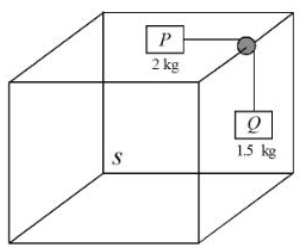
Two blocks (P and Q) with respectively masses 2 kg and 1.5 kg are joined by a massless thread. These blocks are mounted on a frictionless pully which is fixed on the edge of a cube (S), as shown in the figure below. Block P is positioned on the top surface which has no friction and block Q is in contact with side-surface, having coefficient friction $$\mu$$. The cube (S) moves towards the right with acceleration of $$\frac{g}{2}$$, where g is gravitational acceleration. During this movement the block P and Q remain stationary. The value of $$\mu$$ is _______.
(take g = 10 m/s$$^2$$)
NTA JEE Mains 6th April Shift 1 2026 - Question 30
A lift of mass 1600 kg is supported by thick iron wire. If the maximum stress which the wire can withstand is $$4 \times 10^8$$ N/m$$^2$$ and its radius is 4 mm, then maximum acceleration the lift can take is _______ m/s$$^2$$.
(take g = 10 m/s$$^2$$ and $$\pi$$ = 3.14)