NTA JEE Mains 06th April 2024 Shift 2
For the following questions answer them individually
NTA JEE Mains 06th April 2024 Shift 2 - Question 31
Molality ($$m$$) of $$3M$$ aqueous solution of NaCl is : (Given : Density of solution $$= 1.25 \text{ g mL}^{-1}$$, Molar mass in $$\text{gmol}^{-1}$$: Na $$- 23$$, Cl $$- 35.5$$)
NTA JEE Mains 06th April 2024 Shift 2 - Question 32
The ratio $$\frac{K_P}{K_C}$$ for the reaction : $$CO_{(g)} + \frac{1}{2} O_{2(g)} \rightleftharpoons CO_{2(g)}$$ is :
NTA JEE Mains 06th April 2024 Shift 2 - Question 33
Match List - I with List - II.
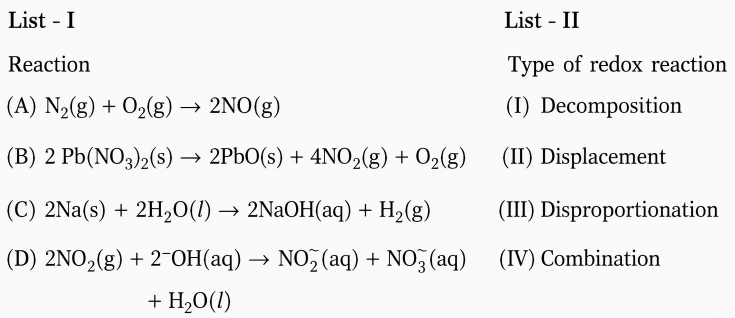
Choose the correct answer from the options given below :

NTA JEE Mains 06th April 2024 Shift 2 - Question 34
The number of ions from the following that are expected to behave as oxidising agent is : $$Sn^{4+}, Sn^{2+}, Pb^{2+}, Tl^{3+}, Pb^{4+}, Tl^{+}$$
NTA JEE Mains 06th April 2024 Shift 2 - Question 35
Evaluate the following statements related to group 14 elements for their correctness. (A) Covalent radius decreases down the group from C to Pb in a regular manner. (B) Electronegativity decreases from C to Pb down the group gradually. (C) Maximum covalance of C is 4 whereas other elements can expand their covalance due to presence of d orbitals. (D) Heavier elements do not form $$p\pi - p\pi$$ bonds. (E) Carbon can exhibit negative oxidation states. Choose the correct answer from the options given below :
NTA JEE Mains 06th April 2024 Shift 2 - Question 36
The correct statement among the following, for a "chromatography" purification method is :
NTA JEE Mains 06th April 2024 Shift 2 - Question 37
The incorrect statement regarding the geometrical isomers of 2-butene is :
NTA JEE Mains 06th April 2024 Shift 2 - Question 38
How can an electrochemical cell be converted into an electrolytic cell?
NTA JEE Mains 06th April 2024 Shift 2 - Question 39
Arrange the following elements in the increasing order of number of unpaired electrons in it. (A) Sc (B) Cr (C) V (D) Ti (E) Mn. Choose the correct answer from the options given below :
NTA JEE Mains 06th April 2024 Shift 2 - Question 40
The correct IUPAC name of $$[PtBr_2(PMe_3)_2]$$ is :