NTA JEE Mains 28th Jan 2026 Shift 2
For the following questions answer them individually
NTA JEE Mains 28th Jan 2026 Shift 2 - Question 11
Considering the principal values of inverse trigonometric functions, the value of the expression $$ \tan\left( 2\sin^{-1} \left( \frac{2}{\sqrt{13}}-2\cos ^{-1}\left( \frac{3}{\sqrt{10}}\right)\right)\right) $$
is equal to:
NTA JEE Mains 28th Jan 2026 Shift 2 - Question 12
Let $$f(x) = \lim_{\theta \to 0}\left(\frac{\cos\pi x - x^{\frac{2}{\theta}} \sin(x - 1)}{1 + x^{\left(\frac{2}{\theta}\right)} (x - 1)}\right), \quad x \in \mathbb{R}$$. Consider the following two statements :
(I) $$f(x)$$ is discontinuous at $$x=1$$.
(II) $$f(x)$$ is continuous at $$x= - 1$$.
Then,
NTA JEE Mains 28th Jan 2026 Shift 2 - Question 13
The probability distribution of a random variable X is given below:
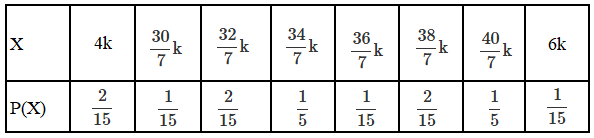
If $$ E(X)=\frac{263}{15} $$. then $$ P(X<20)$$ is equal to:

NTA JEE Mains 28th Jan 2026 Shift 2 - Question 14
Let $$A = \{ z \in \mathbb {C} : |z - 2| \le 4 \}\quad$$ and $$\quad B = \{ z \in \mathbb{C} : |z - 2| + |z + 2| = 5 \}.$$ Then the maximum of $$\left\{ |z_1 - z_2| : z_1 \in A \text{ and } z_2 \in B \right\}text{ is:}$$
NTA JEE Mains 28th Jan 2026 Shift 2 - Question 15
Let $$y = y(x)$$ be the solution of the differential equation $$x\frac{dy}{dx} - y = x^2 \cot x, \quad x \in (0, \pi).$$ If $$y\left(\frac{\pi}{2}\right) = \frac{\pi}{2}$$, then $$6y\left(\frac{\pi}{6}\right) - 8y\left(\frac{\pi}{4}\right)$$ is equal to :
NTA JEE Mains 28th Jan 2026 Shift 2 - Question 16
Let Q(a, b, c) be the image of the point P(3, 2, 1) in the line $$ \frac{x-1}{1} = \frac{y}{2} = \frac{z-1}{1}$$ Then the distance of Q from the line $$ \frac{x-9}{3} = \frac{y-9}{2} = \frac{z-5}{-2} $$ is
NTA JEE Mains 28th Jan 2026 Shift 2 - Question 17
Let A be the focus of the parabolay $$y^{2}=8x$$. Let the line $$y= mx +c$$ intersect the parabola at two distinct points B and C. If the centroid of the triangle ABC is $$\left(\frac {7}{3},\frac{4}{3}\right)$$, then $$ (BC)^{2}$$ is equal to:
NTA JEE Mains 28th Jan 2026 Shift 2 - Question 18
Let the arithmetic mean of $$\dfrac{1}{a}$$ and $$\dfrac{1}{b}$$ be $$\dfrac{5}{16}$$, $$\text{a > 2}$$. If $$\alpha$$ is such that $$ a,\alpha,b $$ are in A.P., then the equation $$\alpha x^{2}-ax+2(\alpha-2b)=0$$ has:
NTA JEE Mains 28th Jan 2026 Shift 2 - Question 19
An ellipse has its center at (1, - 2), one focus at (3, -2) and one vertex at (5, -2). Then the length of its latus rectum is:
NTA JEE Mains 28th Jan 2026 Shift 2 - Question 20
Given below ar e two statements :
Statement I: $$ 25^{13}+20^{13}+8^{13}+3^{13} $$ is divisible by 7.
Statement II: The integral part of $$(7 + 4\sqrt{3})^{25}$$ is an odd number.
ln the light of the above statements , choose the correct answer from the options given be low :