For the following questions answer them individually
Let the ellipse $$E:\frac{x^{2}}{144}+\frac{y^{2}}{169}=1$$ and the hyperbola $$H:\frac{x^{2}}{16}-\frac{y^{2}}{\lambda^{2}}=-1$$ have the same foci. If e and L respectively denote the eccentricity and the length of the latus rectum of H , then the value of 24(e+ L) is:
Given below are two statements :
Statement I : The function $$f:R\rightarrow R $$ defined by $$f(x)=\f\frac{x}{1+\mid x\mid}$$ is one-one.
Statement II : The function $$f:R\rightarrow R $$ defined by $$f(x)=\f\frac{x^{2}+4x-30}{x^{2}-8x+18}$$ is many-one.
In the light of the above statements, choose the correct answer from the options given below :
The sum of the coefficients of $$x^{499} \text{ and }x^{500} \text{ in } (1+x)^{1000}+x(1+x)^{999}+x^{2}(1+x)^{998}+....+x^{1000} \text{ is: }$$
Let P be a point in the plane of the vectors $$ \overrightarrow{AB}=3\widehat{i} + \widehat{j}-\widehat{k} \text{ and }\overrightarrow{AC}=\widehat{i}-\widehat{j}+3\widehat{k}$$ such that P is equidistant from the Lines AB and AC. If $$ \mid \overrightarrow{AP} \mid=\frac{\sqrt{5}}{2} $$ then the area of the triangle ABP is:
The sum of all the elements in the range of $$f(x) =Sgn(\sin x) + Sgn(\cos x) +Sgn(\tan x) +Sg n(\cot x)$$, $$x \neq \frac{n\pi}{2}, n\epsilon Z, \text{ where } Sgn(t)=\begin{cases}1, & \text{ if } t>0\\-1 & \text{ if } t<0\end{cases} ,is:$$
Let $$P_1 : y=4x^2 \text{ and } P_2 : y=x^2 + 27$$ be two parabolas. If the area of the bounded region enclosed between$$P_1$$ and $$P_2$$ is six times the area of the bounded region enclosed between the line $$y = c\alpha x, \alpha > 0 \text{ and } P_1,$$ then $$\alpha$$ is equal to:
Let the circle $$x^{2}+y^{2}=4$$ interesect x-axis at the points A(a,0), a > 0 and B(b, 0). let $$P(2 \cos \alpha, 2 \sin \alpha),0 \lt \alpha \lt \frac{\pi}{2} \text{and } Q(2\cos \beta, 2\sin \beta)$$ be two points such that $$( \alpha - \beta) =\frac {\pi}{2}$$. Then the point of intersection of AQ and BP lies on:
Let $$f(x)=\int\frac{dx}{x^{\left(\frac{2}{3}\right)}+2x^{\left(\frac{1}{2}\right)}} $$ be such that $$f(0)=-26+24\log_{e}{(2)}. \text { If } f(1)=a+b \log_{e}{(3)}, \text{ where } a,b \in Z$$, then a+b is equal to:
$$\dfrac{6}{3^{26}}+\dfrac{10.1}{3^{25}}+\dfrac{10.2}{3^{24}}+\dfrac{10.2^{2}}{3^{23}}+...+\dfrac{10.2^{24}}{3}$$ is equal to :
Let $$[\cdot]$$ denote the greatest integer function. Then $$\int_{-\frac{\pi}{2}}^{\frac{\pi}{2}} \left(\frac{12(3+[x])}{3+[\sin x]+[\cos x]}\right)dx$$ is equal to:
Considering the principal values of inverse trigonometric functions, the value of the expression $$ \tan\left( 2\sin^{-1} \left( \frac{2}{\sqrt{13}}-2\cos ^{-1}\left( \frac{3}{\sqrt{10}}\right)\right)\right) $$
is equal to:
Let $$f(x) = \lim_{\theta \to 0}\left(\frac{\cos\pi x - x^{\frac{2}{\theta}} \sin(x - 1)}{1 + x^{\left(\frac{2}{\theta}\right)} (x - 1)}\right), \quad x \in \mathbb{R}$$. Consider the following two statements :
(I) $$f(x)$$ is discontinuous at $$x=1$$.
(II) $$f(x)$$ is continuous at $$x= - 1$$.
Then,
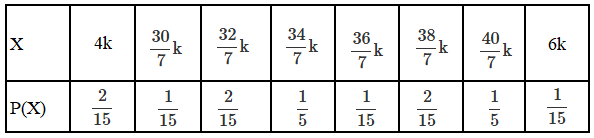
The probability distribution of a random variable X is given below:
If $$ E(X)=\frac{263}{15} $$. then $$ P(X<20)$$ is equal to:
Let $$A = \{ z \in \mathbb {C} : |z - 2| \le 4 \}\quad$$ and $$\quad B = \{ z \in \mathbb{C} : |z - 2| + |z + 2| = 5 \}.$$ Then the maximum of $$\left\{ |z_1 - z_2| : z_1 \in A \text{ and } z_2 \in B \right\}text{ is:}$$
Let $$y = y(x)$$ be the solution of the differential equation $$x\frac{dy}{dx} - y = x^2 \cot x, \quad x \in (0, \pi).$$ If $$y\left(\frac{\pi}{2}\right) = \frac{\pi}{2}$$, then $$6y\left(\frac{\pi}{6}\right) - 8y\left(\frac{\pi}{4}\right)$$ is equal to :
Let Q(a, b, c) be the image of the point P(3, 2, 1) in the line $$ \frac{x-1}{1} = \frac{y}{2} = \frac{z-1}{1}$$ Then the distance of Q from the line $$ \frac{x-9}{3} = \frac{y-9}{2} = \frac{z-5}{-2} $$ is
Let A be the focus of the parabolay $$y^{2}=8x$$. Let the line $$y= mx +c$$ intersect the parabola at two distinct points B and C. If the centroid of the triangle ABC is $$\left(\frac {7}{3},\frac{4}{3}\right)$$, then $$ (BC)^{2}$$ is equal to:
Let the arithmetic mean of $$\dfrac{1}{a}$$ and $$\dfrac{1}{b}$$ be $$\dfrac{5}{16}$$, $$\text{a > 2}$$. If $$\alpha$$ is such that $$ a,\alpha,b $$ are in A.P., then the equation $$\alpha x^{2}-ax+2(\alpha-2b)=0$$ has:
An ellipse has its center at (1, - 2), one focus at (3, -2) and one vertex at (5, -2). Then the length of its latus rectum is:
Given below ar e two statements :
Statement I: $$ 25^{13}+20^{13}+8^{13}+3^{13} $$ is divisible by 7.
Statement II: The integral part of $$(7 + 4\sqrt{3})^{25}$$ is an odd number.
ln the light of the above statements , choose the correct answer from the options given be low :
If $$\sum_{r=1}^{25}\left( \frac{r}{r^{4}+r^{2}+1} \right)=\frac{p}{q},$$ where p and q are positive integers such that gcd(p,q)=1, then p+q is equal to ___________
Three persons enter in a lift at the ground floor. The lift will go upto $$10^{th}$$ floor. The number of ways, in which the three persons can exit the lift at three different floors, if the lift does not stop at first, second and third floors, is equal to________
Let $$A=\begin{bmatrix}3 & -4 \\1 & -1 \end{bmatrix}$$ and B be two matrices such that $$A^{100}=100B+I$$. Then the sum of all the elements of $$B^{100}$$ is_______
Let $$ f$$ be a differentiable function satisfying $$f(x)=1-2x+\int_{0}^{x} e^{(x-t)}f(t)dt, x \in \mathbb{R}$$ and let $$g(x)=\int_{0}^{x} (f(t)+2)^{15}(t-4)^{6}(t+12)^{17}dt, x \in \mathbb{R}.$$ If p and q are respectively the points of local minima and local maxima of g, then the value of $$\mid p+q \mid $$ is equal to _________
If the distance of the point $$P(43, \alpha, \beta), \beta<0,$$ from the line $$\overrightarrow{r} = 4\widehat{i}-\widehat{k}+\mu(2\widehat{i}+3\widehat{k}), \mu \in \mathbb{R}$$ along a line with direction ratios 3, -1, 0 is $$13\sqrt{10},$$ then $$ \alpha ^{2}+ \beta^{2}$$ is equal to______