
Join Our JEE Preparation Group
Prep with like-minded aspirants; Get access to free daily tests and study material.
Sign in
Please select an account to continue using cracku.in
↓ →
Join Our JEE Preparation Group
Prep with like-minded aspirants; Get access to free daily tests and study material.
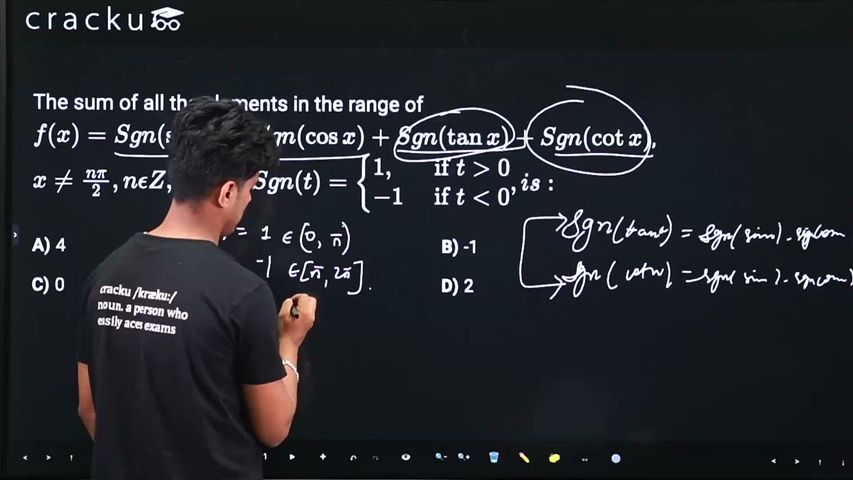
The sum of all the elements in the range of $$f(x) =Sgn(\sin x) + Sgn(\cos x) +Sgn(\tan x) +Sg n(\cot x)$$, $$x \neq \frac{n\pi}{2}, n\epsilon Z, \text{ where } Sgn(t)=\begin{cases}1, & \text{ if } t>0\\-1 & \text{ if } t<0\end{cases} ,is:$$
$$\text{Sgn}(\tan x) = \text{Sgn}(\sin x) \cdot \text{Sgn}(\cos x)$$ and that $$\text{Sgn}(\cot x) = \text{Sgn}(\cos x) \cdot \text{Sgn}(\sin x)$$, it follows that $$\text{Sgn}(\tan x) = \text{Sgn}(\cot x)$$.
Introducing the variables $$a = \text{Sgn}(\sin x) = \pm 1$$ and $$b = \text{Sgn}(\cos x) = \pm 1$$ allows us to express the function as $$f(x) = a + b + 2ab$$.
In Quadrant I where $$a = 1$$ and $$b = 1$$, $$f = 4$$; in Quadrant II where $$a = 1$$ and $$b = -1$$, $$f = -2$$;
in Quadrant III where $$a = -1$$ and $$b = -1$$, $$f = 0$$; and in Quadrant IV where $$a = -1$$ and $$b = 1$$, $$f = -2$$.
Thus the range of $$f$$ is $$\{-2,0,4\}$$ and the sum of these values is $$-2 + 0 + 4 = 2$$
Was this solution helpful?
Click on the Email ☝️ to Watch the Video Solution
Create a FREE account and get:
_1.webp)

Educational materials for JEE preparation

Ask our AI anything

AI can make mistakes. Please verify important information.
AI can make mistakes. Please verify important information.
