For the following questions answer them individually
The sum of all the real solutions of the equation
$$\log_{(x+3)}{(6x^{2}+28x+30)}=5-2\log_{(6x+10)}{(x^{2}+6x+9)}$$ is equal to
Let $$\overrightarrow{a}=\widehat{i}-2\widehat{j}+3\widehat{k}, \overrightarrow{b}=2\widehat{i}+\widehat{j}-\widehat{k}, \overrightarrow{c}=\lambda \widehat{i}+\widehat{j}+\widehat{k}$$ and $$\overrightarrow{v}= \overrightarrow{a} \times \overrightarrow{b}$$. If $$\overrightarrow{v}\cdot\overrightarrow{c}=11$$ and the length of the projection of $$\overrightarrow{b}$$ on $$\overrightarrow{c}$$ is p, then $$9p^{2}$$ is equal to
If $$f(x)= \begin{cases}\frac{a|x|+x^{2}-2(\sin|x|)(\cos|x|)}{x} & ,x \neq 0\\b & ,x = 0\end{cases}$$
is continuous at x = 0, then a + b is equal to
Bag A contains 9 white and 8 black balls, while bag B contains 6 white and 4 black balls. One ball is randomly picked up from the bag B and mixed up with the balls in the bag A. Then a ball is randomly drawn from the bag A. If the probability, that the ball drawn is white, is $$\dfrac{p}{q},gcd(p,q)=1,$$ then $$p+q$$ is equal to
If $$z = \frac{\sqrt{3}}{2}+\frac{i}{2},i=\sqrt{-1},\text{ then }(z^{201}-i)^{8}\text{ is equal to }$$
The number of ways, in which 16 oranges can be distributed to four children such that each child gets at least one orange , is
Let A = {0 ,1,2,...,9}. Let R be a relation on A defined by (x,y) $$\in$$ R if and only if $$\mid x - y \mid $$ is a multiple of 3.
Given below are two statements:
Statement I: $$n (R) = 36.$$
Statement II: R is an equivalence relation.
In the light of the above statements, choose the correct answer from the options given below
Consider two sets $$A=\left\{x\in Z:|(|x-3|-3)\leq1\right\}$$ and $$B=\left\{x \in \mathbb R-\left\{1,2\right\}:\frac{(x-2)(x-4)}{x-1}\log_{e}(|x-2|)=0 \right\}$$. Then the number of onto functions $$f:A\rightarrow B$$ is equal to
If the points of intersection of the ellipses $$x^{2}+2y^{2}-6x-12y+23=0$$ and $$4x^{2}+2y^{2}-20x-12y+35=0$$ lie on a circle of radius r and centre (a, b), then the value of $$ab+18r^{2}$$ is
An equilateral triangle OAB is inscribed in the parabola $$y^{2} = 4x$$ with the vertex O at the vertex of the parabola. Then the minimum distance of the circle having AB as a diameter from the origin is
Let A (1, 2) and C(- 3, -6) be two diagonally opposite vertices of a rhombus, whose sides AD and BC are parallel to the line $$7x - y = 14$$. If B ($$ \alpha, \beta $$) and D ($$ \gamma, \delta $$) are the other two vertices, then $$|\alpha+ \beta+\gamma+\delta |$$ is equal to
Let $$ \frac{\pi}{2} <Â \theta <Â \pi $$ and $$\cot\theta=-\frac{1}{2\sqrt{2}}.$$ Then the value of $$\sin\left( \frac{150}{2}\right)\left(\cos 80 + \sin 80\right)+\cos\left( \frac{150}{2}\right)\left(\cos 80 - \sin 80\right)$$ is equal to
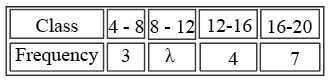
If the mean and the variance of the data
are $$ \mu $$ and 19 respectively, then the value of $$\lambda$$ $$+\mu$$ is
Let $$I(x)=\int\frac{3dx}{\left(4x+6\right)\left(\sqrt{4x^{2}}+8x+3\right)}$$ and $$I(0)=\frac{{\sqrt{3}}}{4}+20.$$
If $$I\left( \frac{1}{2} \right)=\frac{a\sqrt{2}}{b}+c, \text { Where a,b,c } \in N,gcd(a,b)=1, \text{ a+b+c is equal to}$$
The area of the region enclosed between the circles $$x^{2}+y^{2}=4 \text{ and } x^{2}+(y-2)^{2}=4$$ is
Let $$\overrightarrow{a},\overrightarrow{b},\overrightarrow{c}$$ be three vectors such that $$\overrightarrow{a}\times\overrightarrow{b}=2(\overrightarrow{a}\times\overrightarrow{c}).$$ If $$ \mid \overrightarrow{a}\mid, \mid\overrightarrow{b}\mid = 4, \mid \overrightarrow{c}\mid = 2,$$ and the angle between $$\overrightarrow{b}$$ and $$\overrightarrow{c}$$ is $$60^{o}$$, then $$\mid\overrightarrow{a}\cdot\overrightarrow{c}$$ is
The least value of $$(\cos^{2} \theta- 6\sin \theta \cos \theta + 3\sin^{2} \theta +2)$$ is
Let PQ be a chord of the hyperbola $$\frac{x^{2}}{4}-\frac{y^{2}}{b^{2}}=1$$, perpendicular to the x-axis
such that OPQ is an equilateral triangle, O being the centre of the hyperbola. If the eccentricity of the hyperbola is $$\sqrt{3}.$$ then the area of the triangle OPQ is
$$ \text{Let }\sum_{k=1}^n a_k=\alpha n ^2 +\beta n.$$ If $$a_{10}=59$$ and $$ a_6 = 7a_1,$$ then $$ \alpha+\beta $$ is equal to
The system of linear equations
$$x + y + z = 6$$
$$2x + 5y + az =36$$
$$x + 2y + 3z = b$$
If the solution curve $$y =f (x)$$ of the differential equation
$$(x^{2}-4)y^{'}-2xy+2x(4-x^{2})^{2}=0,x>2,$$
passes through the point (3, 15), then the local maximum value of $$f$$ is __________
If the image of the point $$P(a, 2, a)$$ in the line $$\frac{x}{2}=\frac{y+a}{1}=\frac{z}{1}$$ is Q and the image of Q in the line $$\frac{x-2b}{2}=\frac{y-a}{1}=\frac{z+2b}{-5}$$ is P, then a + b is equal to _____.
Let S denote the set of 4-digit numbers $$abcd$$ such that $$a > b > c > d$$ and P denote the set of 5-digit numbers having product of its digits equal to 20. Then $$n(S) + n(P)$$ is equal to ______
The number of elements in the
set $$ S=\left\{ x:x\in [0,100] \text{ and } \int_{0}^{x} t^{2} \sin(x-t)dt=x^{2}\right\}$$ is _________
Let $$A = \begin{bmatrix}0 & 2 & -3 \\-2 & 0 & 1 \\ 3 & -1 & 0 \end{bmatrix}$$ and B be a matrix such that $$B(I- A)=I+A.$$ Then the sumof the diagonal elements of $$B^{T}B$$ is equal to _________