NTA JEE Mains 23rd Jan 2025 Shift 2
For the following questions answer them individually
NTA JEE Mains 23rd Jan 2025 Shift 2 - Question 11
Let the range of the function $$f(x)=6+16\cos x.\cos (\frac{\pi}{3}-x).\cos (\frac{\pi}{3}+x).\sin 3x.\cos 6x, x \in R\text{ be }[\alpha,\beta]$$.Then the distance of the point $$(\alpha,\beta)$$ from the line 3x + 4y + 12 = 0 is :
NTA JEE Mains 23rd Jan 2025 Shift 2 - Question 12
Let x = x(y) be the solution of the differential equation $$y = \left(x-y\frac{dx}{dy}\right)\sin \left(\frac{x}{y}\right),y > 0$$ and $$x(1)=\frac{\pi}{2}$$. Then $$\cos (x(2))$$ is equals to :
NTA JEE Mains 23rd Jan 2025 Shift 2 - Question 13
A spherical chocolate ball has a layer of ice-cream of uniform thickness around it. When the thickness of the ice-cream layer is 1 cm , the ice-cream melts at the rate of $$81 cm^{3}/min$$ and the thickness of the ice-cream layer decreases at the rate of $$\frac{1}{4\pi} cm/min$$. The surface area $$(in cm^{2})$$ of the chocolate ball (without the ice-cream layer) is :

NTA JEE Mains 23rd Jan 2025 Shift 2 - Question 14
The number of complex numbers z, satisfying $$|z|=1\text{ and }|\frac{z}{\overline{z}}+\frac{\overline{z}}{z}| = 1$$, is :
NTA JEE Mains 23rd Jan 2025 Shift 2 - Question 15
Let $$A = [a_{ij}]$$ be $$3\times 3$$ matrix such that $$A\begin{bmatrix}0 \\1\\0 \end{bmatrix} =\begin{bmatrix}0 \\0\\1 \end{bmatrix},A\begin{bmatrix}4 \\1\\3 \end{bmatrix}=\begin{bmatrix}0 \\1\\0 \end{bmatrix}$$ and $$A\begin{bmatrix}2 \\1\\2 \end{bmatrix}=\begin{bmatrix}1 \\0\\0 \end{bmatrix}$$, then $$a_{23}$$ equals :
NTA JEE Mains 23rd Jan 2025 Shift 2 - Question 16
If $$I=\int_{0}^{\frac{\pi}{2}}\frac{\sin^{\frac{3}{2}} x}{\sin^{\frac{3}{2}} x+ \cos^{\frac{3}{2} x}}dx$$, then $$\int_{0}^{21}\frac{x\sin x \cos x}{\sin^{4} x+\cos^{4} x}dx$$ equals :
NTA JEE Mains 23rd Jan 2025 Shift 2 - Question 17
A board has 16 squares as shown in the figure:
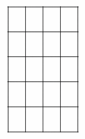
Out of these 16 squares, two squares are chosen at random. The probability that they have no side in common is:
NTA JEE Mains 23rd Jan 2025 Shift 2 - Question 18
Let the shortest distance from (a, 0), a > 0, to the parabola $$y^{2}= 4x$$ be 4. Then the equation of the circle passing through the point (a,0) and the focus of the parabola, and having its centre on the axis of the parabola is:
NTA JEE Mains 23rd Jan 2025 Shift 2 - Question 19
If in the expansion of $$(1+x)^{p}(1-x)^{q}$$, the coefficients of x and $$x^{2}$$ are 1 and -2 , respectively, then $$p^{2}+q^{2}$$ is equal to :
NTA JEE Mains 23rd Jan 2025 Shift 2 - Question 20
If the area of the region $$\{(x,y):-1 \leq x \leq 1, 0 \leq y \leq a + e^{|x|}-e^{-x}, a > 0\}$$ is $$\frac{e^{2}+8e+1}{e}$$, then the value of a is :