NTA JEE Mains 23rd Jan 2025 Shift 1
For the following questions answer them individually
NTA JEE Mains 23rd Jan 2025 Shift 1 - Question 21
Let the circle touch the line x-y+1=0, have the centre on the positive x -axis, and cut off a chord of length $$\frac{4}{\sqrt{13}}$$ along the line -3x+2y=1. Let H be the hyperbola $$\frac{x^{2}}{\alpha^{2}}-\frac{y^{2}}{\beta^{2}}=1$$ , whose one of the foci is the centre of C and the length of the transverse axis is the diameter of C. Then $$2\alpha^{2}+3\beta^{2}$$ is equal to ______
789
456
123
0.-
Clear All
NTA JEE Mains 23rd Jan 2025 Shift 1 - Question 22
If the equation $$a(b-c)x^{2}+b(c-a)x+c(a-b)=0$$ has equal roots, where a+c=15 and $$b=\frac{36}{5}$$, then $$a^{2}+c^{2}$$ is equal to
789
456
123
0.-
Clear All
NTA JEE Mains 23rd Jan 2025 Shift 1 - Question 23
If the set of all values of a, for which the equation $$5x^{3}-15x-a=0$$ has three distinct real roots, is the interval $$(\alpha, \beta)$$, then $$\beta-2\alpha $$ is equal to ______
789
456
123
0.-
Clear All

NTA JEE Mains 23rd Jan 2025 Shift 1 - Question 24
The sum of all rational terms in the expansion of $$(1+2^{1/2}+3^{1/2})^{6}$$ is equal to
789
456
123
0.-
Clear All
NTA JEE Mains 23rd Jan 2025 Shift 1 - Question 25
If the area of the larger portion bounded between the curves $$x^{2}+y^{2}=25$$ and y=|x-1| is $$\frac{1}{4}(b\pi+c),b,c\in N$$, then b+c is equal to
789
456
123
0.-
Clear All
NTA JEE Mains 23rd Jan 2025 Shift 1 - Question 26
A point particle of charge Q is located at P along the axis of an electric dipole 1 at a distance r as shown in the figure. The point P is also on the equatorial plane of a second electric dipole 2 at a distance r . The dipoles are made of opposite charge q separated by a distance 2a. For the charge particle at P not to experience any net
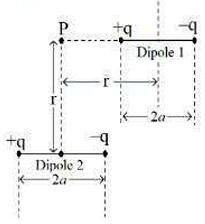
force, which of the following correctly describes the situation?
NTA JEE Mains 23rd Jan 2025 Shift 1 - Question 27
A spherical surface of radius of curvature R, separates air from glass (refractive index = 1.5). The centre of curvature is in the glass medium. A point object $$'O'$$ placed in air on the optic axis of the surface, so that its real image is formed at $$'I'$$ inside glass. The line $$OI$$ intersects the spherical surface at $$P$$ and $$PO=PI$$ . The distance $$PO$$ equals to
NTA JEE Mains 23rd Jan 2025 Shift 1 - Question 28
The position of a particle moving on x-axis is given by $$x(t)=A\sin t+B\cos^{2}t+Ct^{2}+D$$, where is time. The dimension of $$\frac{ABC}{D}$$ is
NTA JEE Mains 23rd Jan 2025 Shift 1 - Question 29
Given a thin convex lens (refractive index $$\mu_{2}$$), kept in a liquid (refractive index $$\mu_{1},\mu_{1}<\mu_{2}$$) having radii of curvatures $$|R_{1}|$$ and $$|R_{2}|$$ . Its second surface is silver polished. Where should an object be placed on the optic axis so that a real and inverted image is formed at the same place?
NTA JEE Mains 23rd Jan 2025 Shift 1 - Question 30
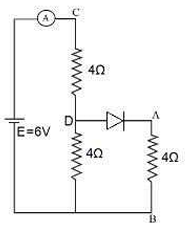
Refer to the circuit diagram given in the figure. which of the following observations are correct? A. Total resistance of circuit is $$6\Omega$$ B. Current in Ammeter is 1 A C. Potential across AB is 4 Volts. D. Potential across CD is 4 Volts E. Total resistance of the circuit is $$8\Omega$$ . Choose the correct answer from the options given below: