NTA JEE Mains 22nd Jan 2026 Shift 1
For the following questions answer them individually
NTA JEE Mains 22nd Jan 2026 Shift 1 - Question 21
If $$\int (\sin x) ^{\frac{-11}{2}}(\cos x)^{\frac{-5}{2}}dx= -\frac{p_{1}}{q_{1}}(\cot x)^{\frac{9}{2}}-\frac{p_{2}}{q_{2}}(\cot x)^{\frac{5}{2}}-\frac{p_{3}}{q_{3}}(\cot x)^{\frac{1}{2}}+ \frac{p_{4}}{q_{4}}(\cot x)^{\frac{-3}{2}}+C,\text{ where }p_{i} \text{ and } q_{i} $$ are positive integers with $$gcd(p_{i}, q_{i}) = l$$ for i = l, 2, 3, 4 and C is the constant of integration, then $$\frac{15p_{1}p_{2}p_{3}p_{4}}{q_{1}q_{2}q_{3}q_{4}} $$ is equal to ______
789
456
123
0.-
Clear All
NTA JEE Mains 22nd Jan 2026 Shift 1 - Question 22
If $$\dfrac{\cos^{2}48^{o}-\sin^{2}12^{o}}{\sin^{2}24^{o}-\sin^{2}6^{o}}=\dfrac{\alpha+\beta\sqrt{5}}{2}$$, where $$\alpha, \beta \text{ }\epsilon \text{ }N$$, then $$\alpha + \beta $$ is equal to ________
789
456
123
0.-
Clear All
NTA JEE Mains 22nd Jan 2026 Shift 1 - Question 23
Let $$ABC$$ be a triangle. Consider four points $$p_{1},p_{2},p_{3},p_{4}$$ on the side AB, five points $$p_{5},p_{6},p_{7},p_{8},p_{9}$$ on the side $$BC$$, and four points $$p_{10},p_{11},p_{12},p_{13}$$ on the side $$AC$$. None of these points is a vertex of the trinagle $$ABC$$. Then the total number of pentagons, that can be formed by taking all the vertices from the points $$p_{1},p_{2},... ,p_{13}$$, is_______
789
456
123
0.-
Clear All

NTA JEE Mains 22nd Jan 2026 Shift 1 - Question 24
Let $$\alpha = \frac{-1+i\sqrt{3}}{2}$$ and $$ \beta=\frac{-1-i\sqrt{3}}{2},i=\sqrt{-1}.$$
If $$(7-7\alpha+9\beta)^{20}+(9+7\alpha+7\beta)^{20}+(-7+9\alpha+7\beta)^{20}+(14+7\alpha+7\beta)^{20}=m^{10},$$ then $$m$$ is
789
456
123
0.-
Clear All
NTA JEE Mains 22nd Jan 2026 Shift 1 - Question 25
Let A be a $$3 \times 3$$ matrix such that A+ A^{T} = 0. If $$A\begin{bmatrix} 1 \\-1 \\ 0 \end{bmatrix}=\begin{bmatrix} 3 \\3 \\ 2 \end{bmatrix},A^{2}\begin{bmatrix} 1 \\-1 \\ 0 \end{bmatrix}=\begin{bmatrix} -3 \\19 \\ -24 \end{bmatrix}$$ and $$det(adj(2 adj(A+I))) = (2)^{\alpha }\cdot (3)^{\beta}\cdot (11)^{\gamma},\alpha,\beta,\gamma$$ are non-negative integers, then $$\alpha+\beta+\gamma$$ is equal to _____
789
456
123
0.-
Clear All
NTA JEE Mains 22nd Jan 2026 Shift 1 - Question 26
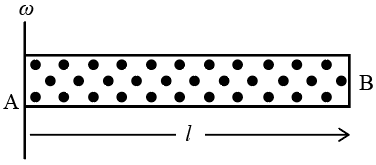
A cylindrical tube $$AB$$ of length $$l$$, closed at both ends contains an ideal gas of 1 mol having molecular weight $$M$$. The tube is rotated in a horizontal plane with constant angular velocity $$\omega$$ about an axis pe1pendicular to $$AB$$ and passing through the edge at end $$A$$ , as shown in the figure. If $$P_{A}$$ and $$P_{B}$$ are the pressures at $$A$$ and $$B$$ respectively, then
(Consider the temperature is same at all points in the tube)
NTA JEE Mains 22nd Jan 2026 Shift 1 - Question 27
Consider an equilateral prism (refractive index $$\sqrt{2}$$). A ray of light is incident on its one surface at a certain angle $$i$$. If the emergent ray is found to graze along the other surface then the angle of refraction at the incident surface is close to ______.
NTA JEE Mains 22nd Jan 2026 Shift 1 - Question 28
The volume of an ideal gas increases 8 times and temperature becomes $$(1/4)^{th}$$ of initial temperature during a reversible change. If there is no exchange of heat in this process $$(\triangle Q = 0)$$ then identify the gas from the following options (Assuming the gases given in the options are ideal gases):
NTA JEE Mains 22nd Jan 2026 Shift 1 - Question 29
A thin convex lens of focal length 5 cm and a thin concave lens of focal length 4 cm are combined together (without any gap) and this combination has magnification $$m_{1}$$ when an object is placed 10 cm before the convex lens. Keeping the positions of convex lens and object undisturbed a gap of 1 cm is introduced between the lenses by moving the concave lens away, which lead to a change in magnification of total lens system to $$m_{2}$$.
The value of $$ \mid\frac{m_{1}}{m_{2}}\mid $$ is______.
NTA JEE Mains 22nd Jan 2026 Shift 1 - Question 30
$$7.9 MeV \alpha - \text{particle}$$ scatters from a target material of atomic muuber 79. From the given data the estimated diameter of nuclei of the target material is (approximately) ___m.
$$\left[ \frac{1}{4\pi \epsilon_{o}}=9\times 10^{9} Nm^{2}/c^{2} \text{ and electron change}=1.6\times 10^{-19}C \right ]$$