
Join Our JEE Preparation Group
Prep with like-minded aspirants; Get access to free daily tests and study material.
Sign in
Please select an account to continue using cracku.in
↓ →
Join Our JEE Preparation Group
Prep with like-minded aspirants; Get access to free daily tests and study material.
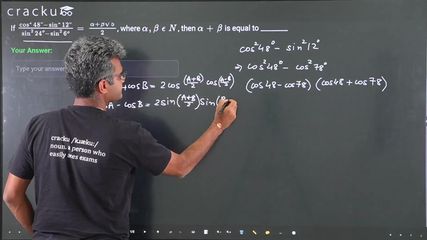
If $$\dfrac{\cos^{2}48^{o}-\sin^{2}12^{o}}{\sin^{2}24^{o}-\sin^{2}6^{o}}=\dfrac{\alpha+\beta\sqrt{5}}{2}$$, where $$\alpha, \beta \text{ }\epsilon \text{ }N$$, then $$\alpha + \beta $$ is equal to ________
Correct Answer: 4
We know that $$\cos\theta=\sin(90-\theta)$$
Thus, $$\cos 48^\circ=\sin (90-48)^\circ=\sin 42^\circ$$
$$\dfrac{\sin^{2}42^{o}-\sin^{2}12^{o}}{\sin^{2}24^{o}-\sin^{2}6^{o}}$$
$$\dfrac{\left(\sin42^o-\sin12^o\right)\left(\sin42^o+\sin12^o\right)}{\left(\sin24^o-\sin6^o\right)\left(\sin24^o+\sin6^o\right)}$$
Now, we know that -
$$\sin A-\sin B=2\cos\left(\frac{A+B}{2}\right)\sin\left(\frac{A-B}{2}\right)$$
$$\sin A+\sin B=2\sin\left(\frac{A+B}{2}\right)\cos\left(\frac{A-B}{2}\right)$$
Thus, the given equation will become -
$$\dfrac{2\cos27^o\sin15^o\times2\sin27^o\cos15^o}{2\cos15^o\sin9^o\times2\sin15^o\cos9^o}$$ (Also, $$2\sin A\cos A = \sin 2A$$)
$$\dfrac{\sin54^o\times\sin30^o}{\sin30^o\times\sin18^o}$$
$$\dfrac{\sin54^o}{\sin18^o}$$
Also, $$\sin54^o=\dfrac{\sqrt{5}+1}{4}$$ and $$\sin18^o=\dfrac{\sqrt{5}-1}{4}$$. Therefore, the fraction becomes -
$$\dfrac{\frac{\sqrt{5}+1}{4}}{\frac{\sqrt{5}-1}{4}}=\dfrac{\sqrt{5}+1}{\sqrt{5}-1}\times\dfrac{\sqrt{5}+1}{\sqrt{5}+1}=\dfrac{\left(\sqrt{5}+1\right)^2}{4}=\dfrac{6+2\sqrt{5}}{4}=\dfrac{3+\sqrt{5}}{2}$$
Thus, $$\alpha=3$$ and $$\beta=1$$
$$\alpha+\beta=3+1=4$$
Was this solution helpful?
Click on the Email ☝️ to Watch the Video Solution
Create a FREE account and get:
_1.webp)

Educational materials for JEE preparation

Ask our AI anything

AI can make mistakes. Please verify important information.
AI can make mistakes. Please verify important information.
