For the following questions answer them individually
Applying the principle of homogeneity of dimensions, determine which one is correct, where $$T$$ is time period, $$G$$ is gravitational constant, $$M$$ is mass, $$r$$ is radius of orbit.
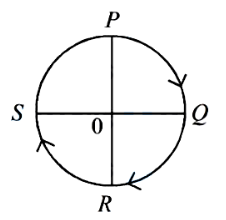
A cyclist starts from the point $$P$$ of a circular ground of radius $$2$$ km and travels along its circumference to the point $$S$$. The displacement of a cyclist is:
A $$2$$ kg brick begins to slide over a surface which is inclined at an angle of $$45°$$ with respect to horizontal axis. The co-efficient of static friction between their surfaces is:
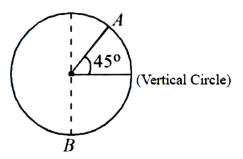
A body of $$m$$ kg slides from rest along the curve of vertical circle from point $$A$$ to $$B$$ in friction less path. The velocity of the body at $$B$$ is: (given, $$R = 14$$ m, $$g = 10$$ m/s$$^2$$ and $$\sqrt{2} = 1.4$$)
A $$90$$ kg body placed at $$2R$$ distance from surface of earth experiences gravitational pull of: ($$R$$ = Radius of earth, $$g = 10$$ m s$$^{-2}$$)
Correct formula for height of a satellite from earth's surface is:
Given below are two statements: Statement I: The contact angle between a solid and a liquid is a property of the material of the solid and liquid as well. Statement II: The rise of a liquid in a capillary tube does not depend on the inner radius of the tube. In the light of the above statements, choose the correct answer from the options given below:
A sample of gas at temperature $$T$$ is adiabatically expanded to double its volume. Adiabatic constant for the gas is $$\gamma = 3/2$$. The work done by the gas in the process is: ($$\mu = 1$$ mole)
The translational degrees of freedom $$(f_t)$$ and rotational degrees of freedom $$(f_r)$$ of $$CH_4$$ molecule are:
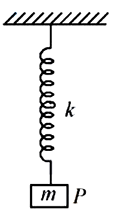
In simple harmonic motion, the total mechanical energy of given system is $$E$$. If mass of oscillating particle $$P$$ is doubled then the new energy of the system for same amplitude is
A charge $$q$$ is placed at the center of one of the surface of a cube. The flux linked with the cube is:
An electric bulb rated $$50$$ W $$- 200$$ V is connected across a $$100$$ V supply. The power dissipation of the bulb is:
The magnetic moment of a bar magnet is $$0.5$$ Am$$^2$$. It is suspended in a uniform magnetic field of $$8 \times 10^{-2}$$ T. The work done in rotating it from its most stable to most unstable position is:
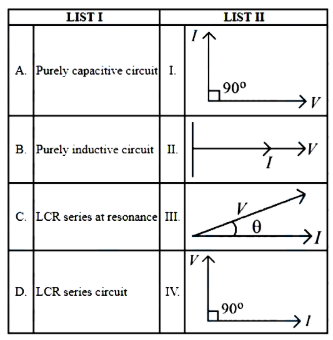
Match List I with List II:

Choose the correct answer from the options given below:
Arrange the following in the ascending order of wavelength: A. Gamma rays $$(\lambda_1)$$, B. x-rays $$(\lambda_2)$$, C. Infrared waves $$(\lambda_3)$$, D. Microwaves $$(\lambda_4)$$. Choose the most appropriate answer from the options given below:
The width of one of the two slits in a Young's double slit experiment is 4 times that of the other slit. The ratio of the maximum of the minimum intensity in the interference pattern is:
Given below are two statements: one is labelled as Assertion A and the other is labelled as Reason R. Assertion A: Number of photons increases with increase in frequency of light. Reason R: Maximum kinetic energy of emitted electrons increases with the frequency of incident radiation. In the light of the above statements, choose the most appropriate answer from the options given below:
According to Bohr's theory, the moment of momentum of an electron revolving in $$4^{th}$$ orbit of hydrogen atom is:
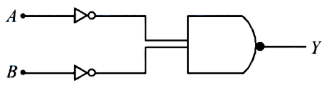
Identify the logic gate given in the circuit:
Which of the diode circuit shows correct biasing used for the measurement of dynamic resistance of p-n junction diode:
A bus moving along a straight highway with speed of $$72$$ km/h is brought to halt within $$4$$ s after applying the brakes. The distance travelled by the bus during this time (Assume the retardation is uniform) is _____ m.
In a system two particles of masses $$m_1 = 3$$ kg and $$m_2 = 2$$ kg are placed at certain distance from each other. The particle of mass $$m_1$$ is moved towards the center of mass of the system through a distance $$2$$ cm. In order to keep the center of mass of the system at the original position, the particle of mass $$m_2$$ should move towards the center of mass by the distance _____ cm.
Mercury is filled in a tube of radius $$2$$ cm up to a height of $$30$$ cm. The force exerted by mercury on the bottom of the tube is _____ N. (Given, atmospheric pressure $$= 10^5$$ Nm$$^{-2}$$, density of mercury $$= 1.36 \times 10^4$$ kg m$$^{-3}$$, $$g = 10$$ m s$$^{-2}$$, $$\pi = \frac{22}{7}$$)
The displacement of a particle executing SHM is given by $$x = 10 \sin\left(\omega t + \frac{\pi}{3}\right)$$ m. The time period of motion is $$3.14$$ s. The velocity of the particle at $$t = 0$$ is _____ m/s.
A parallel plate capacitor of capacitance $$12.5$$ pF is charged by a battery connected between its plates to potential difference of $$12.0$$ V. The battery is now disconnected and a dielectric slab ($$\epsilon_r = 6$$) is inserted between the plates. The change in its potential energy after inserting the dielectric slab is _____ $$ 10^{-12}$$ J.
Two wires $$A$$ and $$B$$ are made up of the same material and have the same mass. Wire $$A$$ has radius of $$2.0$$ mm and wire $$B$$ has radius of $$4.0$$ mm. The resistance of wire $$B$$ is $$2\Omega$$. The resistance of wire $$A$$ is _____ $$\Omega$$.
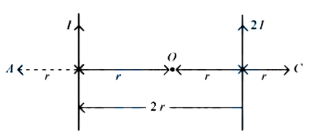
Two parallel long current carrying wire separated by a distance $$2r$$ are shown in the figure. The ratio of magnetic field at $$A$$ to the magnetic field produced at $$C$$ is $$\frac{x}{7}$$. The value of $$x$$ is _____
A rod of length $$60$$ cm rotates with a uniform angular velocity $$20$$ rad s$$^{-1}$$ about its perpendicular bisector, in a uniform magnetic field $$0.5$$ T. The direction of magnetic field is parallel to the axis of rotation. The potential difference between the two ends of the rod is _____ V.
A light ray is incident on a glass slab of thickness $$4\sqrt{3}$$ cm and refractive index $$\sqrt{2}$$. The angle of incidence is equal to the critical angle for the glass slab with air. The lateral displacement of ray after passing through glass slab is _____ cm. (Given $$\sin 15° = 0.25$$)
The disintegration energy $$Q$$ for the nuclear fission of $$^{235}U \rightarrow ^{140}Ce + ^{94}Zr + n$$ is _____ MeV. Given atomic masses of $$^{235}U : 235.0439$$ u; $$^{140}Ce : 139.9054$$ u; $$^{94}Zr : 93.9063$$ u; $$n : 1.0086$$ u, Value of $$c^2 = 931$$ MeV/u