NTA JEE Main 9th April 2019 Shift 2
For the following questions answer them individually
NTA JEE Main 9th April 2019 Shift 2 - Question 21
A moving coil galvanometer has a coil with 175 turns and area 1 cm$$^2$$. It uses a torsion band of torsion constant $$10^{-6}$$ N m/rad. The coil is placed in a magnetic field B parallel to its plane. The coil deflects by 1° for a current of 1 mA. The value of B (in tesla) is approximately:
NTA JEE Main 9th April 2019 Shift 2 - Question 22
A very long solenoid of radius R is carrying current $$I(t) = kte^{-\alpha t}$$ (k > 0), as a function of time (t $$\ge$$ 0). Counterclockwise current is taken to be positive. A circular conducting coil of radius 2R is placed in the equatorial plane of the solenoid and concentric with the solenoid. The current induced in the outer coil is correctly depicted, as a function of time, by:
NTA JEE Main 9th April 2019 Shift 2 - Question 23
Sunlight of intensity 50 W m$$^{-2}$$ is incident normally on the surface of a solar panel. Some part of incident energy (25%) is reflected from the surface and the rest is absorbed. The force exerted on 1 m$$^2$$ surface area will be close to ($$c = 3 \times 10^8$$ m s$$^{-1}$$):

NTA JEE Main 9th April 2019 Shift 2 - Question 24
A convex lens of focal length 20 cm produces images of the same magnification 2 when an object is kept at two distances $$x_1$$ and $$x_2$$ ($$x_1 > x_2$$) from the lens. The ratio of $$x_1$$ and $$x_2$$ is:
NTA JEE Main 9th April 2019 Shift 2 - Question 25
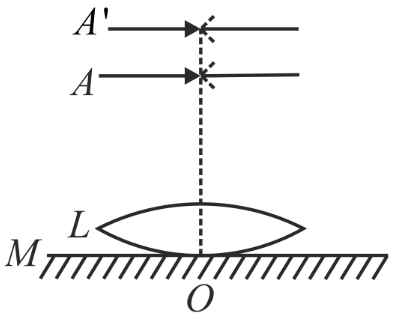
A thin convex lens L (refractive index = 1.5) is placed on a plane mirror M. When a pin is placed at A, such that OA = 18 cm, its real inverted image is formed at A itself, as shown in figure. When liquid of refractive index $$\mu_l$$ is put between the lens and the mirror, the pin has to be moved to A', such that OA' = 27 cm, to get its inverted real image at A' itself. The value of $$\mu_l$$ will be:
NTA JEE Main 9th April 2019 Shift 2 - Question 26
Diameter of the objective lens of a telescope is 250 cm. For light of wavelength 600 nm coming from a distant object, the limit of resolution of the telescope is close to:
NTA JEE Main 9th April 2019 Shift 2 - Question 27
A particle 'P' is formed due to a completely inelastic collision of particles 'x' and 'y' having de-Broglie wavelengths '$$\lambda_x$$' and '$$\lambda_y$$' respectively. If x and y were moving in opposite directions, then the de-Broglie wavelength of 'P' is:
NTA JEE Main 9th April 2019 Shift 2 - Question 28
A He$$^+$$ ion is in its first excited state. Its ionization energy is:
NTA JEE Main 9th April 2019 Shift 2 - Question 29
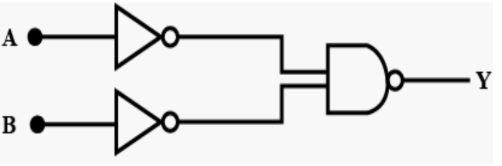
The logic gate equivalent to the given logic circuit is:
NTA JEE Main 9th April 2019 Shift 2 - Question 30
The physical sizes of the transmitter and receiver antenna in a communication system are: