NTA JEE Main 9th April 2019 Shift 2
For the following questions answer them individually
NTA JEE Main 9th April 2019 Shift 2 - Question 1
The area of a square is 5.29 cm$$^2$$. The area of 7 such squares taking into account the significant figures is:
NTA JEE Main 9th April 2019 Shift 2 - Question 2
The position of a particle as a function of time t, is given by $$x(t) = at + bt^2 - ct^3$$ where a, b and c are constants. When the particles zero acceleration, then its velocity will be:
NTA JEE Main 9th April 2019 Shift 2 - Question 3
The position vector of a particle changes with time according to the relation $$\vec{r}(t) = 15t^2\hat{i} + (4 - 20t^2)\hat{j}$$. What is the magnitude of the acceleration at $$t = 1$$?

NTA JEE Main 9th April 2019 Shift 2 - Question 4
A wedge of mass $$M = 4m$$ lies on a frictionless plane. A particle of mass $$m$$ approaches the wedge with speed $$v$$. There is no friction between the particle and the plane or between the particle and the wedge. The maximum height climbed by the particle on the wedge is given by:
NTA JEE Main 9th April 2019 Shift 2 - Question 5
A particle of mass $$m$$ is moving with speed $$2v$$ and collides with a mass $$2m$$ moving with speed $$v$$ in the same direction. After the collision, the first mass is stopped completely while the second one splits into two particles each of mass $$m$$, which move at an angle 45° with respect to the original direction. The speed of each of the moving particle will be:
NTA JEE Main 9th April 2019 Shift 2 - Question 6
A thin smooth rod of length L and mass M is rotating freely with angular speed $$\omega_0$$ about an axis perpendicular to the rod and passing through center. Two beads of mass m and negligible size are at the center of the rod initially.The beads of mass $$m$$ and negligible size are at the center of the rod initially. The beads are free to slide along the rod. The angular speed of the system, when the beads reach the opposite ends of the rod, will be:
NTA JEE Main 9th April 2019 Shift 2 - Question 7
Moment of inertia of a body about a given axis is 1.5 kg m$$^2$$. Initially the body is at rest. In order to produce a rotational kinetic energy of 1200 J, the angular acceleration of 20 rad/s$$^2$$ must be applied about the axis for a duration of:
NTA JEE Main 9th April 2019 Shift 2 - Question 8
A test particle is moving in a circular orbit in the gravitational field produced by a mass density $$\rho(r) = \frac{K}{r^2}$$. Identify the current relation between the radius R of the particle's orbit and its period T:
NTA JEE Main 9th April 2019 Shift 2 - Question 9
A wooden block floating in a bucket of water has $$\frac{4}{5}$$ of its volume submerged. When certain amount of an oil is poured into the bucket, it is found that the block is just under the oil surface with half of its volume under water and half in oil. The density of oil relative to that of water is:
NTA JEE Main 9th April 2019 Shift 2 - Question 10
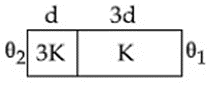
Two materials having coefficients of thermal conductivity 3K and K and thickness d and 3d respectively, are joined to form a slab as shown in the figure. The temperatures of the outer surfaces are $$\theta_2$$ and $$\theta_1$$ respectively, $$(\theta_2 > \theta_1)$$. The temperature at the interface is: