NTA JEE Main 8th April 2019 Shift 2
For the following questions answer them individually
NTA JEE Main 8th April 2019 Shift 2 - Question 11
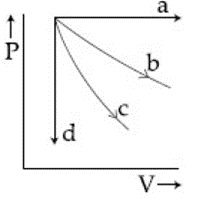
The given diagram shows four processes i.e., isochoric, isobaric, isothermal and adiabatic. The correct assignment of the processes, in the same order is given by:
NTA JEE Main 8th April 2019 Shift 2 - Question 12
The temperature, at which the root mean square velocity of hydrogen molecules equals their escape velocity from the earth, is closest to:
[Boltzmann Constant $$k_B = 1.38 \times 10^{-23}$$ J/K, Avogadro number $$N_A = 6.02 \times 10^{26}$$/kg, Radius of Earth: $$6.4 \times 10^{6}$$ m, Gravitational acceleration on Earth = 10 ms$$^{-2}$$]
NTA JEE Main 8th April 2019 Shift 2 - Question 13
A damped harmonic oscillator has a frequency of 5 oscillations per second. The amplitude drops to half its value for every 10 oscillations. The time it will take to drop to $$\frac{1}{1000}$$ of the original amplitude is close to:

NTA JEE Main 8th April 2019 Shift 2 - Question 14
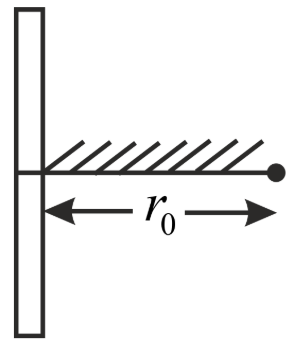
A positive point charge is released from rest at a distance $$r_0$$ from a positive line charge with uniform charge density. The speed (v) of the point charge, as a function of instantaneous distance r from line charge, is proportional to:
NTA JEE Main 8th April 2019 Shift 2 - Question 15
An electric dipole is formed by two equal and opposite charges q with separation d. The charges have same mass m. It is kept in a uniform electric field E. If it is slightly rotated from its equilibrium orientation, then its angular frequency $$\omega$$ is:
NTA JEE Main 8th April 2019 Shift 2 - Question 16
The electric field in a region is given by $$\vec{E} = (Ax + B)\hat{i}$$, where E is in NC$$^{-1}$$ and $$x$$ is in metres. The values of constants are A = 20 SI unit and B = 10 SI unit. If the potential at $$x = 1$$ is $$V_1$$ and that at $$x = -5$$ is $$V_2$$, then $$V_1 - V_2$$ is:
NTA JEE Main 8th April 2019 Shift 2 - Question 17
A parallel plate capacitor has 1$$\mu$$F capacitance. One of its two plates is given +2$$\mu$$C charge and the other plate, +4$$\mu$$C charge. The potential difference developed across the capacitor is:
NTA JEE Main 8th April 2019 Shift 2 - Question 18
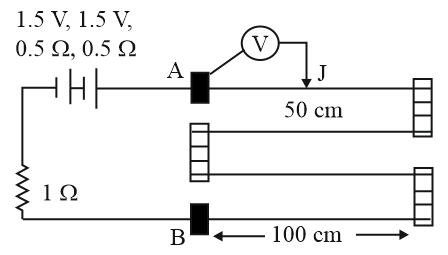
In the circuit shown, a four-wire potentiometer is made of a 400 cm long wire, which extends between A and B. The resistance per unit length of the potentiometer wire is r = 0.01 $$\Omega$$/cm. If an ideal voltmeter is connected as shown with jockey J at 50 cm from end A, the expected reading of the voltmeter will be:
NTA JEE Main 8th April 2019 Shift 2 - Question 19
A cell of internal resistance r drives current through an external resistance R. The power delivered by the cell to the external resistance will be maximum when:
NTA JEE Main 8th April 2019 Shift 2 - Question 20
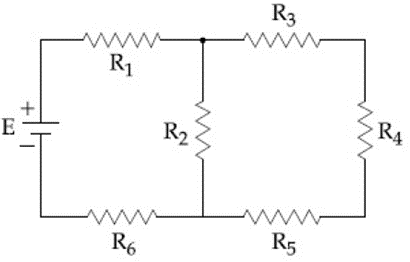
In the figure shown, what is the current (in Ampere) drawn from the battery? You are given: $$R_1 = 15 \; \Omega$$, $$R_2 = 10 \; \Omega$$, $$R_3 = 20 \; \Omega$$, $$R_4 = 5 \; \Omega$$, $$R_5 = 25 \; \Omega$$, $$R_6 = 30 \; \Omega$$, $$E = 15$$ V