NTA JEE Main 8th April 2019 Shift 2
For the following questions answer them individually
NTA JEE Main 8th April 2019 Shift 2 - Question 1
Let $$\vec{A_1} = 3$$, $$\vec{A_2} = 5$$ and $$\vec{A_1} + \vec{A_2} = 5$$. The value of $$\left(2\vec{A_1} + 3\vec{A_2}\right) \cdot \left(3\vec{A_1} - 2\vec{A_2}\right)$$ is:
NTA JEE Main 8th April 2019 Shift 2 - Question 2
In a simple pendulum experiment for determination of acceleration due to gravity (g), time taken for 20 oscillations is measured by using a watch of 1 second least count. The mean value of time taken comes out to be 30 s. The length of the pendulum is measured by using a meter scale of least count 1 mm and the value obtained is 55.0 cm. The percentage error in the determination of g is close to:
NTA JEE Main 8th April 2019 Shift 2 - Question 3
If Surface tension (S), Moment of Inertia (I) and Planck's constant (h), were to be taken as the fundamental units, the dimensional formula for linear momentum would be:

NTA JEE Main 8th April 2019 Shift 2 - Question 4
A particle starts from origin O from rest and moves with a uniform acceleration along the positive $$x$$-axis. Identify all figures that correctly represent the motion qualitatively. (a = acceleration, v = velocity, x = displacement, t = time)
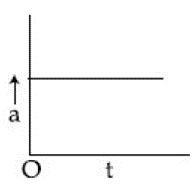
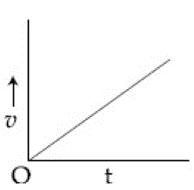
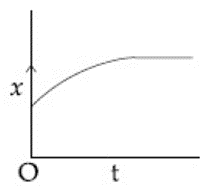
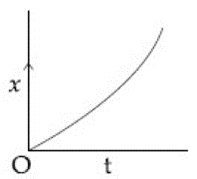
NTA JEE Main 8th April 2019 Shift 2 - Question 5
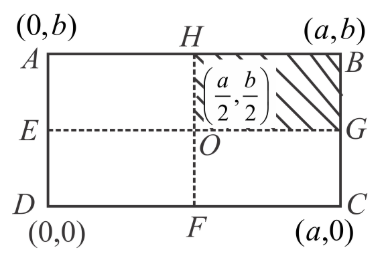
A uniform rectangular thin sheet $$ABCD$$ of mass $$M$$ has length $$a$$ and breadth $$b$$, as shown in the figure. If the shaded portion $$HBGO$$ is cut-off, the coordinates of the centre of mass of the remaining portion will be:
NTA JEE Main 8th April 2019 Shift 2 - Question 6
A body of mass $$m_1$$ moving with an unknown velocity of $$v_1 \hat{i}$$, undergoes a collinear collision with a body of mass $$m_2$$ moving with a velocity $$v_2 \hat{i}$$. After the collision, $$m_1$$ and $$m_2$$ move with velocities of $$v_3 \hat{i}$$ and $$v_4 \hat{i}$$, respectively. If $$m_2 = 0.5 m_1$$ and $$v_3 = 0.5 v_1$$, then $$v_1$$ is:
NTA JEE Main 8th April 2019 Shift 2 - Question 7
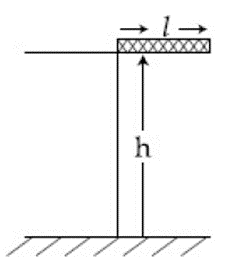
A rectangular solid box of length 0.3 m is held horizontally, with one of its sides on the edge of a platform of height 5 m. When released, it slips off the table in a very short time $$\tau = 0.01$$ s, remaining essentially horizontal. The angle by which it would rotate when it hits the ground will be (in radians) close to:
NTA JEE Main 8th April 2019 Shift 2 - Question 8
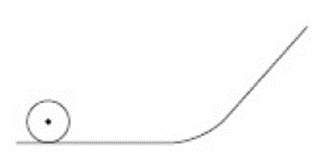
A solid sphere and solid cylinder of identical radii approach an incline with the same linear velocity (see figure). Both roll without slipping all throughout. The two climb maximum heights $$h_{sph}$$ and $$h_{cyl}$$ on the incline. The ratio $$\frac{h_{sph}}{h_{cyl}}$$ is given by:
NTA JEE Main 8th April 2019 Shift 2 - Question 9
A rocket has to be launched from earth in such a way that it never returns. If $$E$$ is the minimum energy delivered by the rocket launcher, what should be the minimum energy that the launcher should have, if the same rocket is to be launched from the surface of the moon? Assume that the density of the earth and the moon are equal and that the earth's volume is 64 times the volume of the moon.
NTA JEE Main 8th April 2019 Shift 2 - Question 10
Young's moduli of two wires A and B are in the ratio 7:4. Wire A is 2 m long and has radius R. Wire B is 1.5 m long and has radius 2 mm. If the two wires stretch by the same length for a given load, the value of R is close to: